
Inaugural Margoliouth Lecture: Reflections from Arabic student Anne-Sophie
The great splendours and tragedies of Damascus belong to memory and prophecy alike; as the current Margoliouth Fellow, Christian Sahner, writes, it is “a palimpsest upon which each age writes its griefs and glories, without ever quite erasing the hand of the last.”
The return of Arabic and Middle Eastern Studies to New College hangs suspended between the Damascus of D S Margoliouth, and that of his successor, C S Sahner. If Margoliouth observed a city emerging from the sectarian devastation of the 1860 Massacre into the ambitious reconstruction of Fuad Pasha’s late Ottoman order; Sahner Among the Ruins encountered a Syria of renewed fragmentation: the return of sectarian anxieties, suspicions of foreign loyalties, and the dangerous estrangement of minority from majority. It is precisely through this dual lens, of societal collapse, and of the arduous labour required to repair a civilisation after trauma, that Syria confronts its present condition.
The old and the new exist not in opposition, but in cyclical succession and preservation. Eugene Rogan delivered the inaugural Margoliouth Lecture in these terms when presenting the events of 1860 as both a “Destruction of the Old Ottoman World,” and “Making of the Modern Middle East.” Drawing upon his discovery of the lost works of Mikhāʾīl Mishāqa, the first American vice-consul in Damascus, Rogan traced how a city convulsed by sectarian violence became the unlikely site of one of the Ottoman Empire’s most ambitious programmes of reconstruction. The aftermath of the massacre was marked by severe measures imposed across confessional and social lines: executions, forced evacuations, taxation, and conscription sought to restore civic order, whilst reparations for the devastated Christian quarters were administered through committees composed of Muslim and Jewish authorities. The Provincial Reform Law of 1864, together with the establishment of the Syrian vilayet and Damascus as its capital, channelled unprecedented revenues into programmes of infrastructural expansion and urban renewal. Telegraph networks, administrative institutions, and reconstructed markets integrated Damascus into new circuits of commerce and governance, whilst the public works they generated increasingly drew sects into shared civic and commercial spaces. Prosperity, Rogan observed, possesses “a wonderful way of encouraging people to leave behind past antagonisms.” By the close of the nineteenth century, civic pride had begun, at least partially, to supersede sectarian identity, reflected in one Damascene’s boast during the visit of Kaiser Wilhelm II that “the souqs of Damascus are famous for their spaciousness and beauty,” such that even European dignitaries possessed “no architecture to rival them.”
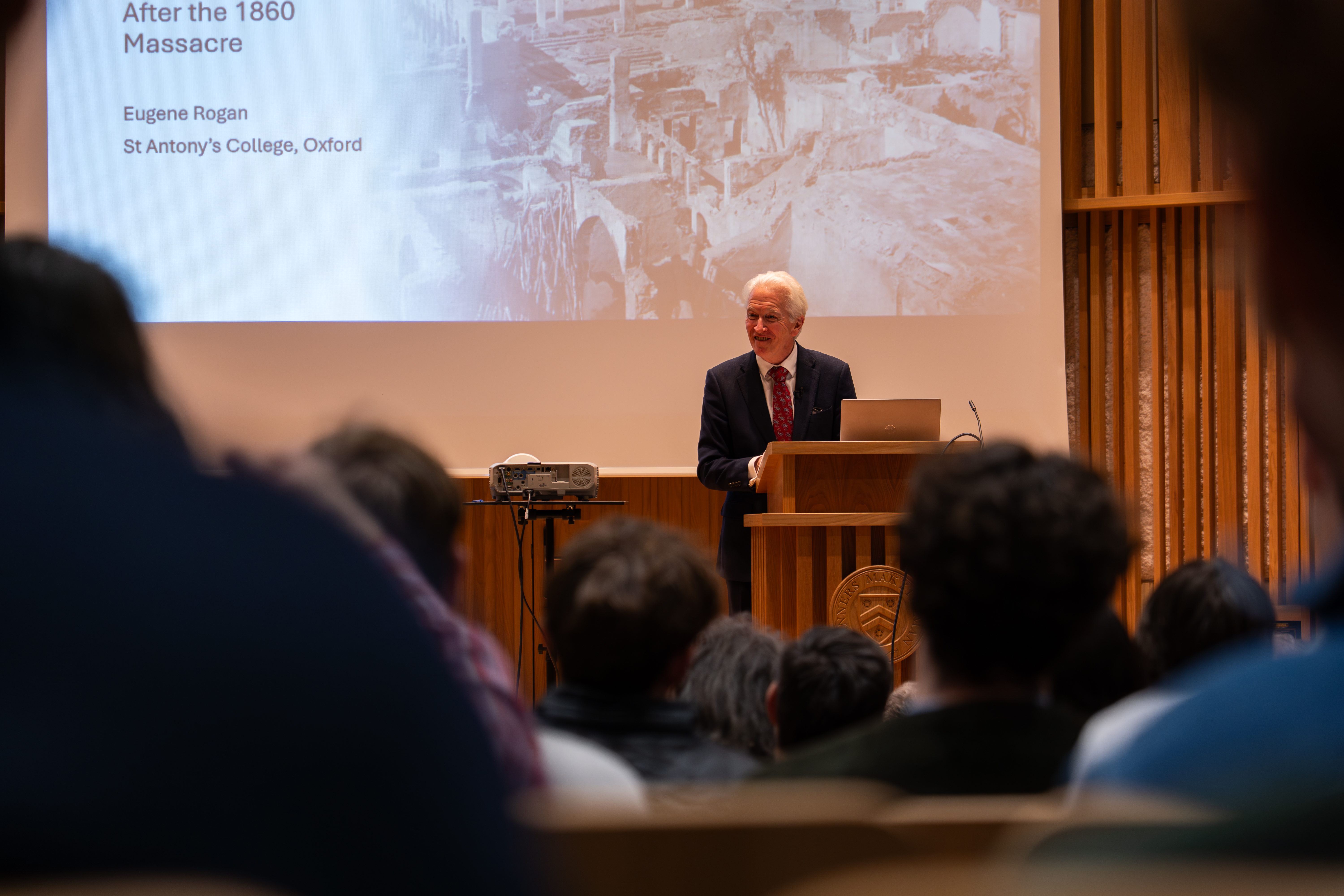
Rogan illustrates that the multifaceted and pluralistic continuity of Syrian society was never an anomaly, nor sectarianism its natural condition. Rather, communal violence flourished where governance failed and where foreign intervention deepened local divisions. For Margoliouth, the beauty of Damascus thus resided “rather in its natural than its artificial endowments.” Its “luxurious vegetation” and “copious waters," set against the surrounding aridity, evoked for him “eastern conceptions of paradise,” as though the landscape itself preserved a permanence beyond the fragility of political order. In Syria’s natural world, Margoliouth discerned something enduring and restorative: beyond the physical remains of empire there persisted a land capable, despite conquest and ruin, of sustaining both memory and life across the centuries.
Rogan concludes, ‘we give thanks to that old city of Damascus, in that it has survived the conflict intact, symbolically bridging the Ottoman past, present, and an uncertain future.’ Whether by word of Margoliouth, Rogan’s account of reconstruction after 1860, Sahner’s Syria in the wake of the Arab Spring and the onset of civil war, or the Syria of today, the image of ruins emerges not as a symbol of devastation alone, but of survival: a marker of a country in perpetual transformation, renewed even through the upheavals that threaten to destroy it. One is left with the consoling sense that the past remains present within the land itself and that what once lived and flourished in Syria may yet endure again.