
New College hosts discussion on the future of the shipping industry
Yesterday evening, industry leaders, academics and interested students gathered at New College to examine one of the most pressing challenges in global trade: decarbonising the shipping sector. The event was hosted by the Zero Institute in collaboration with CMA CGM and the Environmental Change Institute.
The Future of Shipping brought together experts from the University of Oxford and beyond for a panel discussion followed by a networking reception aimed at students exploring careers in the shipping sector. Discussions spanned key issues including alternative fuels, global trade modelling and the growing intersection between shipping, food security and the hydrogen economy.
Farid Trad, Vice President of Bunkering & Energy Transition at CMA CGM honestly assessed the industry's recent volatility: since 2020, global shipping has faced 'super shocks', such as the COVID-19 pandemic, the blockage of the Suez Canal, ongoing port congestion, shifting trade patterns due to tariffs and geopolitical tensions around key routes such as the Strait of Hormuz.
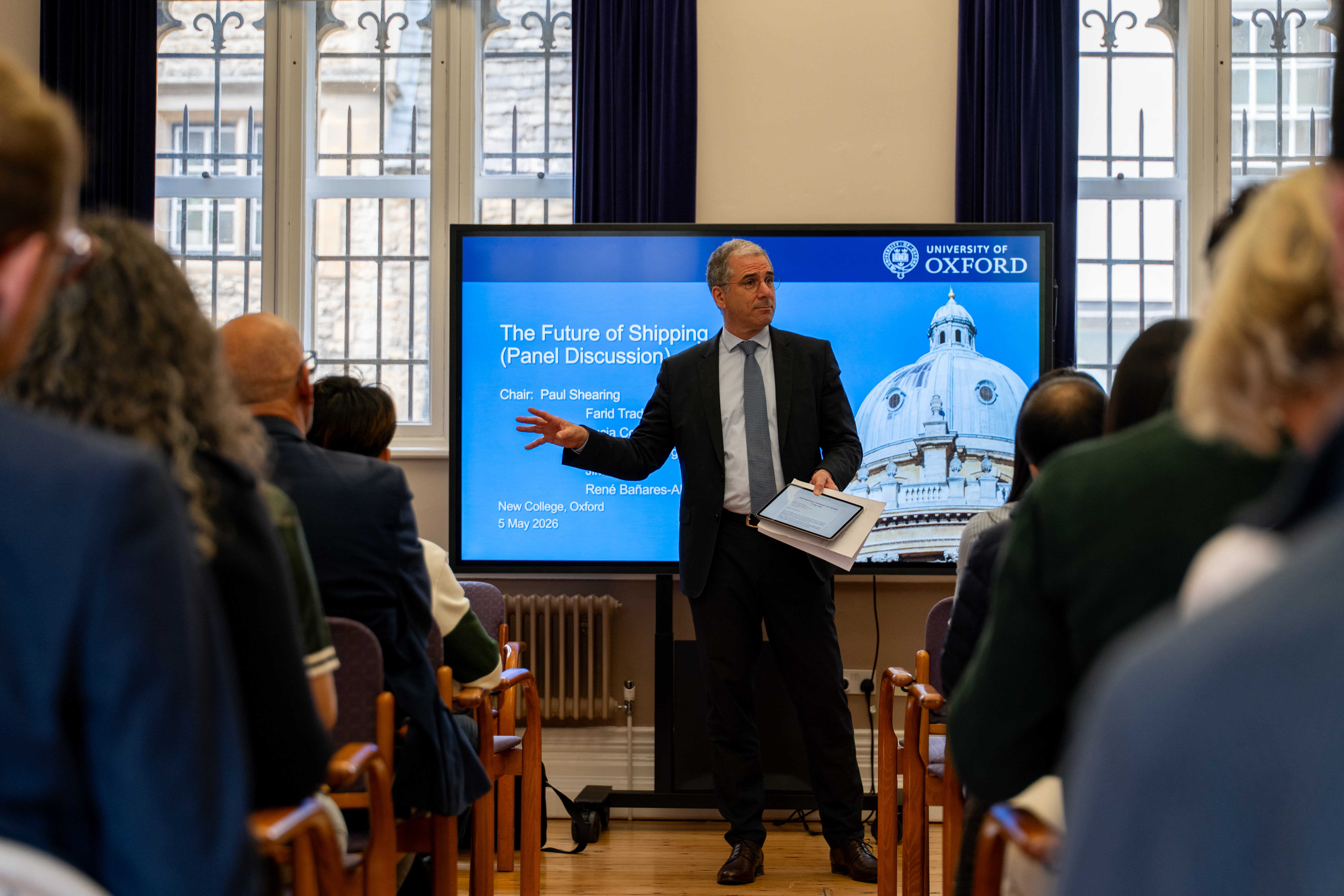
These disruptions have fundamentally reshaped how shipping companies must operate. 'The plan of today will not be the plan of tomorrow', Trad suggested, emphasising the need for constant operational agility and flexibility.
Trad stressed that decarbonisation cannot be achieved by shipping companies alone. Instead, it requires coordination across the entire supply chain, from energy producers and ports to logistics operators and end customers: 'Green energy only works if the whole system is aligned.'
The panel also featured leading Oxford experts, Lucia Corsini, Jim Hall, Konstantina Vogiatzaki, René Bañares-Alcántara, and chair Paul Shearing, who explored the technical, economic, and policy dimensions of shipping’s transition.