
Judge Theodor Meron offers his reflections on Holocaust Memorial Day
Last night's Holocaust Memorial Day lecture was a powerful and moving reminder of the enduring responsibility to remember, learn and act. New College was honoured to welcome Judge Theodor Meron, who offered his reflections on his experience of the Holocaust and the importance of commemorating the millions of victims and those affected by its horrors.
As a child and teenager, Judge Meron survived the Holocaust in ghettos and a labour camp. He was later smuggled out of Communist Poland and studied law at the Universities of Jerusalem, Harvard and Cambridge.
In his lecture, Meron reflected on the Holocaust not only as a historical event, but as a warning. He emphasised that the descent into genocide did not begin with gas chambers, but with words, laws, and the systematic erosion of human dignity. We build a better future by trying to understand the horrors of the Holocaust and learning from history, Meron suggested.
Central to his message was the role of the bystander. Meron cautioned against becoming a bystander, and letting hatred and atrocities occur. By contrast, he argued that when a body politic stands up to the rule of law, this has a powerful effect.
The talk was book-ended with two of Meron's own poems, included in his recently published book, Poems on Being, on Love, and on Grief. He spoke into the therapeutic nature of poetry, reflecting that it helped him psychologically and was 'soothing to the soul'.
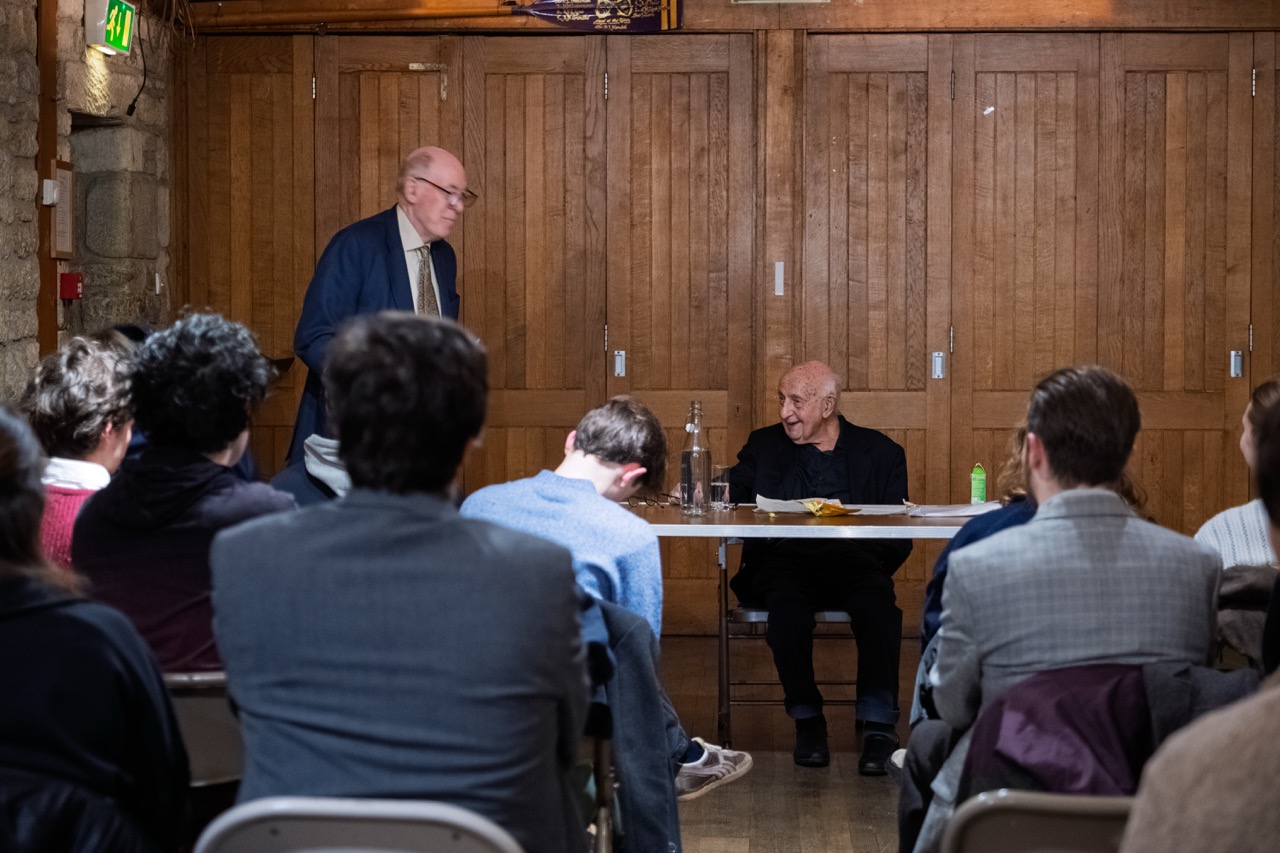
Judge Meron has had distinguished and varied careers as a diplomat at the rank of Ambassador, Legal Adviser to the Foreign Ministry of Israel, Counsellor on International Law to the US State Department, and President of UN War Crimes Tribunals, as a leading professor of law, and now as a visiting professor of law in Oxford and Honorary Fellow of Trinity College. He has written landmark decisions on genocide, crimes against humanity, and war crimes. As a legal adviser in Israel, he authored a famous opinion in 1967 declaring the illegality of settlements in the West Bank.
A leading scholar of international humanitarian law, human rights, and international criminal law, Judge Meron is the author of twelve books, mostly on international law and two on chivalry in Shakespeare. He has taught at NYU Law School, Harvard, Geneva, and Oxford. He has been honorary President of the American Society of International Law, Editor-in-Chief of the American Journal of International Law, and Visiting Fellow of All Souls College, Oxford; he is Charles L. Denison Professor of Law Emeritus at NYU Law School and, since 2014, a Visiting Professor of Law at Oxford University. He was special adviser to the Prosecutor of the International Criminal Court (2022-2025).
Born in Poland in 1930, Meron has been a Judge and, between March 2012 and January 2019, was the President of the International Residual Mechanism for Criminal Tribunals (Mechanism). He was also the President of the Appeals Chambers of the International Criminal Tribunal for the former Yugoslavia (ICTY) and the International Criminal Tribunal for Rwanda (ICTR).