
Dr Thomas Monahan contributes to study analysing second largest megatsunami
10th August 2025: a wave measuring 481m occurred in Tracy Arm fjord in Alaska. Despite a heavily visited destination for cruise ships, remarkably no boats were caught when 60 million cubic meters of rock collapsed into the fjord, triggering the second largest mega tsunami ever recorded.
This 'near-miss' event underscores the increasing risk of natural hazards in arctic regions which are happening more frequently as a consequence of climate change. The tsunami was unequivocally driven by climate change, with the rapid glacial retreat over the past decades making it possible for a tsunami to occur in the first place.
In a new study, an international team of researchers including New College's Dr Thomas Monahan used a combination of satellite data, seismic recordings and numerical modelling to better understand the event. Monahan was part of the team that analysed seismic data to identify the signal of the wave, discovering a series of long-lived oscillations that continued to reverberate through the fjord long after the initial wave:
'Building on my work which identified the first such event a year ago, I helped to understand this standing wave using a new type of satellite altimeter, alongside seismic and simulation data. From this, we coined the term Lanslide-induced seiche (LIS).'
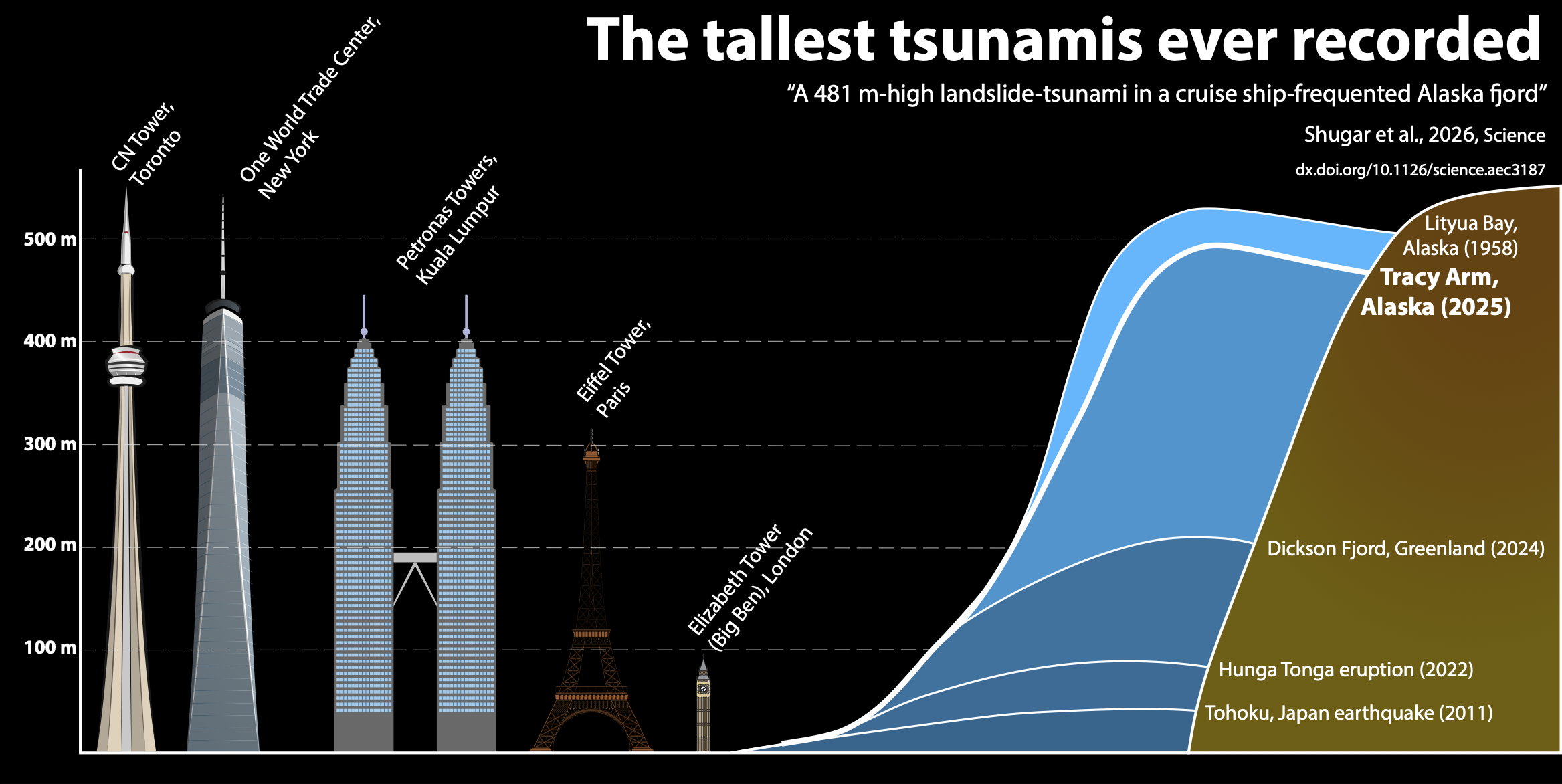
The Tracy Arm fjord produced a complex motion pattern of overlapping water oscillations, unlike the first standing wave (seiche) observed in Dickson Fjord in East Greenland where the water moved in a single, simple rhythm. This observation allowed the team to demonstrate that each basin has its own 'calling card', marked resonant oscillations that are unique to specific fjord.
Monahan's research and the team's discovery has opened up new possibilities for detecting and monitoring hazardous events, even in remote regions with little observation.
Dr Monahan reflected on the need for future-proof methods of observing these natural events:
'While several cruise companies already cancelled their tours of Tracy's Arm fjord this summer, arctic tourism is on the rise as a whole. The solution for some companies has been to simply opt to go to a fjord to the South, Endicott Arm. However, there is no evidence that this fjord is any safer than Tracy's Arm other than that a tsunami has not yet occurred there. Mitigating these hazards requires the development of improved warning systems, but this will take time. We were lucky nobody was killed, but as these events grow more frequent, and the human risks more likely, serious thought needs to be given to regulations on arctic tourism.'