Why New College?
As a subject, Arabic is both old and new at New College.
For many years, undergraduates could study Arabic and other oriental languages, as they were then known. The college’s most distinguished graduate in the subject was D.S. Margoliouth (d. 1940), who became a towering figure of Arabic and Islamic studies in Britain during the first half of the twentieth century. Following his student days, Margoliouth became a fellow of New College and then Oxford’s Laudian Professor of Arabic, one of the oldest Arabic chairs in Europe, established in 1636. (For more on Margoliouth’s life and connection to the college, see the recent collection of essays about him in New College Notes).
Arabic was discontinued at New College for a time, but it was revived in 2024, inspired by Margoliouth’s legacy. This is an exciting development for the college given its long association with the study of the Middle East and its reputation for excellence in languages, history, and other humanities fields.
Although most Arabic classes are taught centrally in the Faculty of Asian and Middle Eastern Studies—where New College students learn alongside others from an array of Oxford colleges—New College offers its own programme of lectures, seminars, and special events. The centrepiece of this programme is the annual Margoliouth Lecture on the History of the Middle East, which brings leading scholars of the region to New College to discuss the important connections between past and present (For a recording of the inaugural Margoliouth Lecture in 2026, delivered by Professor Eugene Rogan of St Antony’s College, Oxford, see here).
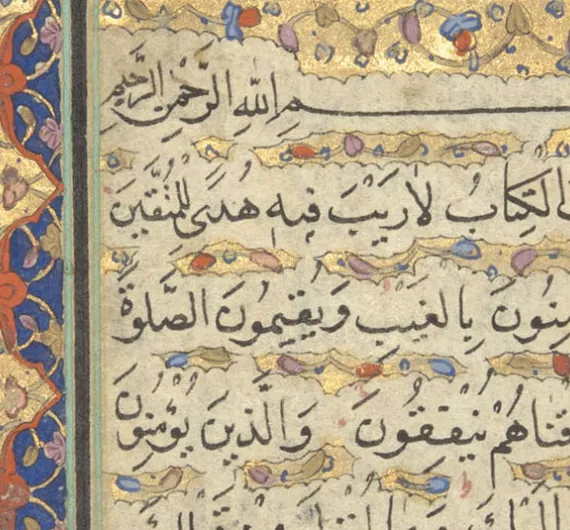
Students of Arabic at New College also benefit from opportunities to travel in the region, both during the compulsory year abroad (usually in Jordan or Tunisia) and the summers. Students also have the chance to work with one of the finest collections of oriental manuscripts in Oxford. (For more on this collection, see here).
Places available
4 in total for Arabic and Joint Schools.
What we look for
The Arabic course at Oxford is about more than just language. While students spend a significant amount of time learning to speak, read, write, and listen in Arabic, the goal is also to apply these skills to other academic endeavours, including studying history, literature, religion, politics, art, and anthropology.
For this reason, we are looking for students who combine an aptitude for languages with a general curiosity about the Middle East and the broader Arab world. We are also looking for students who can think critically and independently and who are open to learning about new cultures and ideas. This is a course for beginners, and we do not expect applicants to have studied Arabic before applying nor do we expect them to have studied the Middle East in great detail. The BA in Arabic is intended to provide an immersive introduction to both the language and the region in which it is spoken. (To watch a short video about the Arabic course at New College, see here).
In preparing for your interview, it is important to find time for some independent reading (material in translation is fine, or indeed literature in English) so that you can determine whether the Oxford course is right for you.
The BA in Arabic fosters a range of transferrable skills. It teaches students to evaluate and master evidence; to analyse arguments; to conduct research; and to express their thoughts precisely and persuasively. Arabic is also demanding, and therefore, studying it fosters linguistic precision and sensitivity. We look for students who can excel in such a course, regardless of whether their future careers involve Arabic and the Middle East.
Tutors' research interests
Professor Christian Sahner is a historian of Late Antiquity and the Middle Ages, focusing on North Africa, the Middle East, and Central Asia. His work explores the rise of Islam, relations between Muslims and non-Muslims (including Christians and Zoroastrians), religious conversion, and the connected histories of the Umayyad, ʿAbbasid, and Byzantine empires.
Along with Professor Sahner, students of Arabic at New College are taught by a variety of postholders in the Faculty of Asian and Middle Eastern Studies who are affiliated with other Oxford colleges.
Joint Schools
New College accepts applications for Joint Schools with Modern Languages (known as EMEL, “European and Middle Eastern Languages”). Applications for EMEL should be exclusively with French, German, or Russian.
New College also accepts applications for Classics and Asian and Middle Eastern Studies, in which students may take up Arabic during the second part of the degree. This course is administered by Classics.


Find out more about all the courses for which New College accepts applications.
Discover more about New College