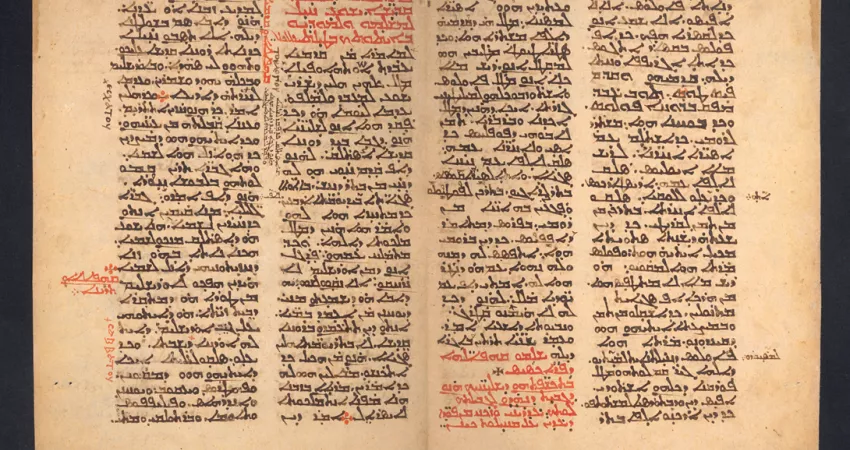
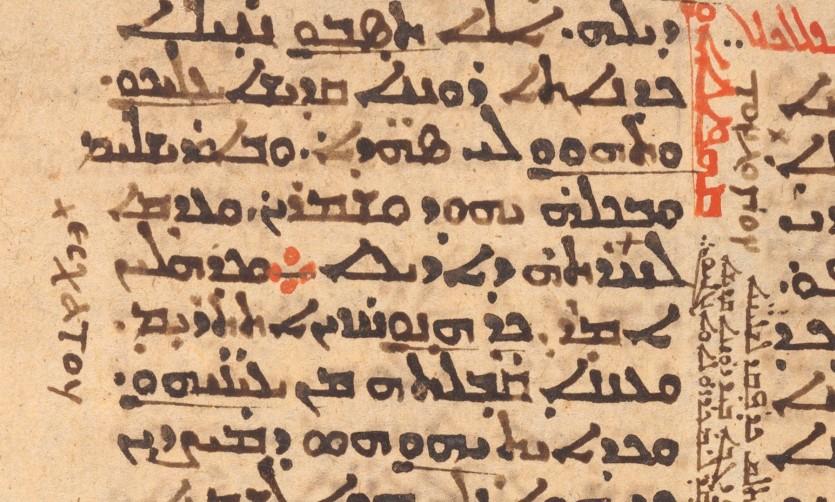
MS 333 is one of the manuscripts on which the printed edition was based, as Ridley deposited all his working materials in New College Library. The beautiful opening above (ff. 141v–140r) highlights its distinctive Syriac script in all its glory. This section marks the opening of the Book of Acts.
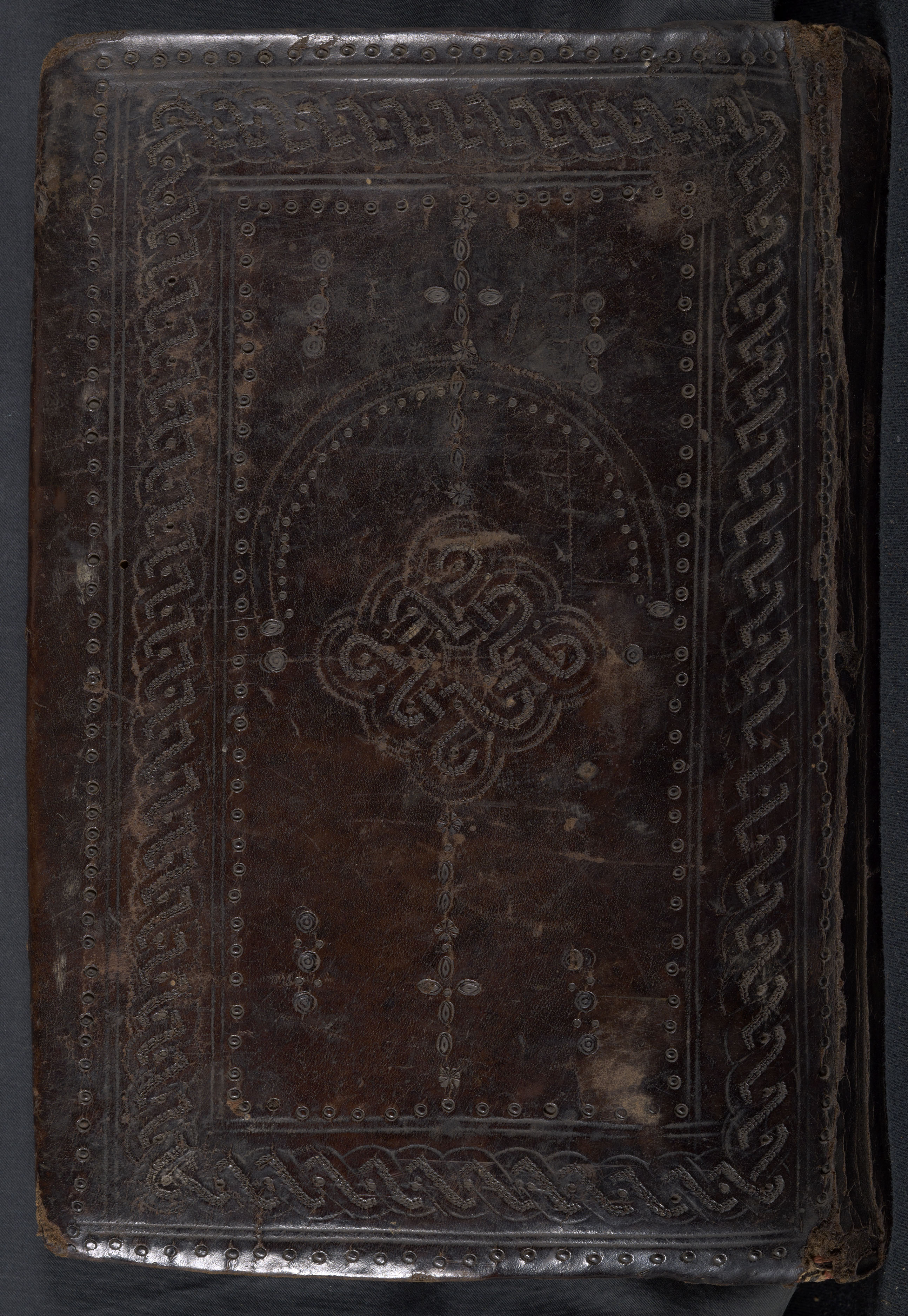 MS 333, though, is not the only Syriac manuscript in New College Library’s extensive collections. Written on the finest cotton paper, MS 331 is also in the distinctive Syriac language. Like MS 333, it has a particularly beautiful binding (pictured here). Note the carefully engraved geometric shapes in the centre of the binding and along its intricate border.
Dating from the early 12th century, the manuscript is a compendium of several Christian and other philosophical works. The renowned Hebrew scholar, translator, and poet Raphael Loewe (1919–2011) has identified one of these texts to be Contra Judeos—an anti-Jewish work written by Ephraem Syrus, or Ephrem the Syrian (c. 306–373). A prominent early Christian theologian, Ephraem is especially revered in Syriac Christianity and in the Eastern Orthodox Church. Several texts written by him had an anti-Jewish tone, with Ephraem wishing to create a demarcation between his own relatively young Christian faith and the much older Jewish faith following the Council of Nicaea in CE 325.
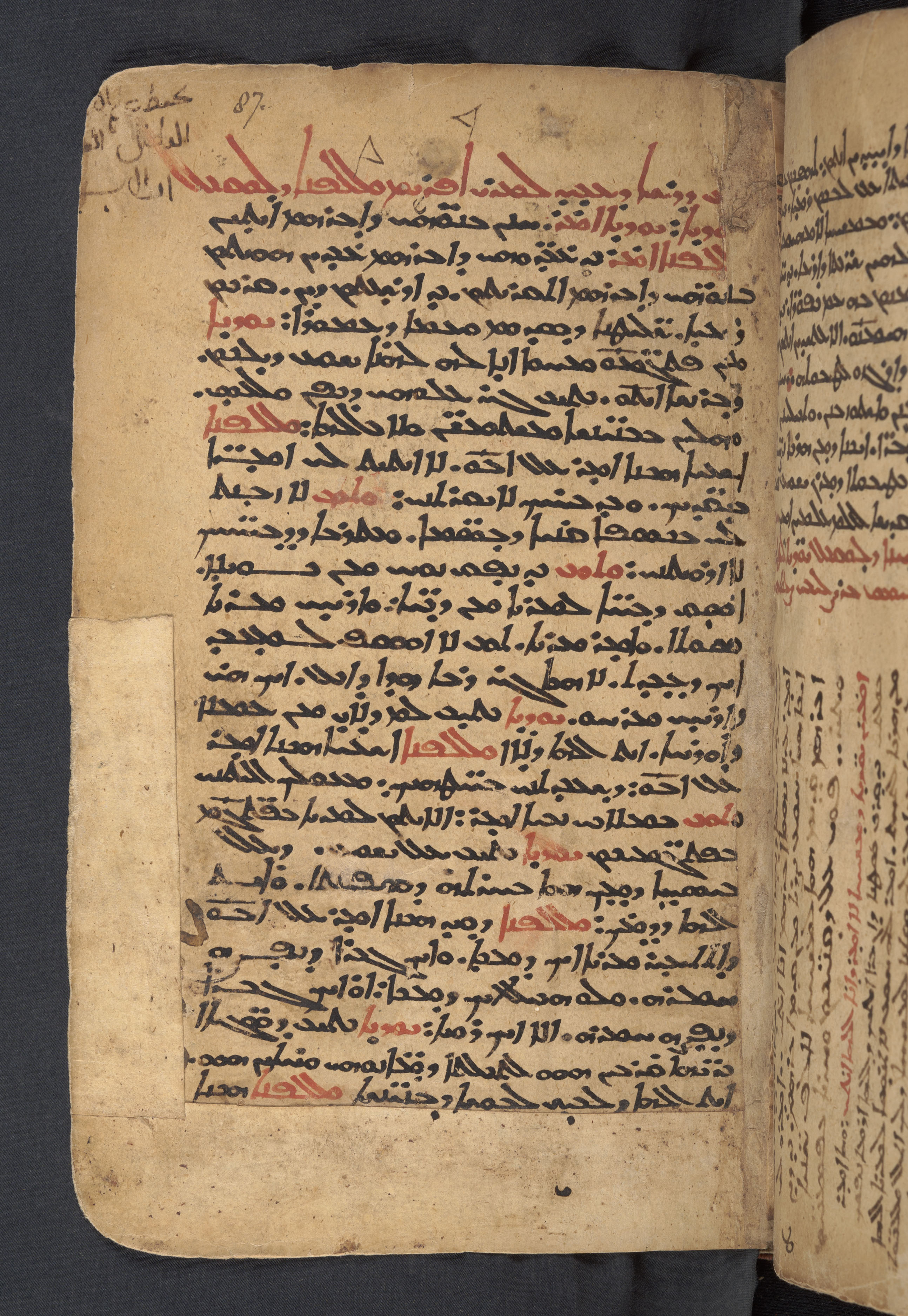 Here, you can see an example opening from the centre of the manuscript. It highlights both its decoration—note the rubrication in the red ink that appears throughout this book—and its usage throughout the centuries. At the bottom left of this page (f. 87v), you can see the results of some careful paper conservation, added to protect the original leaf from any further damage.
Unfortunately, we do not know precisely when this manuscript came to New College, as there is no evidence for an accession date. As we know that New College fellow Glocester Ridley was interested in the Syriac language, though, this manuscript may have arrived together with MS 333 in the first half of the 18th century.
The final work in our Syriac trilogy is much more recent than the other two highlighted on this page. MS 345, pictured below, is another Syriac version of the Gospels that dates from the eighteenth century. The first part of a pair of manuscripts, this first volume contains the Gospel of Matthew and the Gospel of Mark. The second volume, MS 346 contains the Gospels of Luke and John.
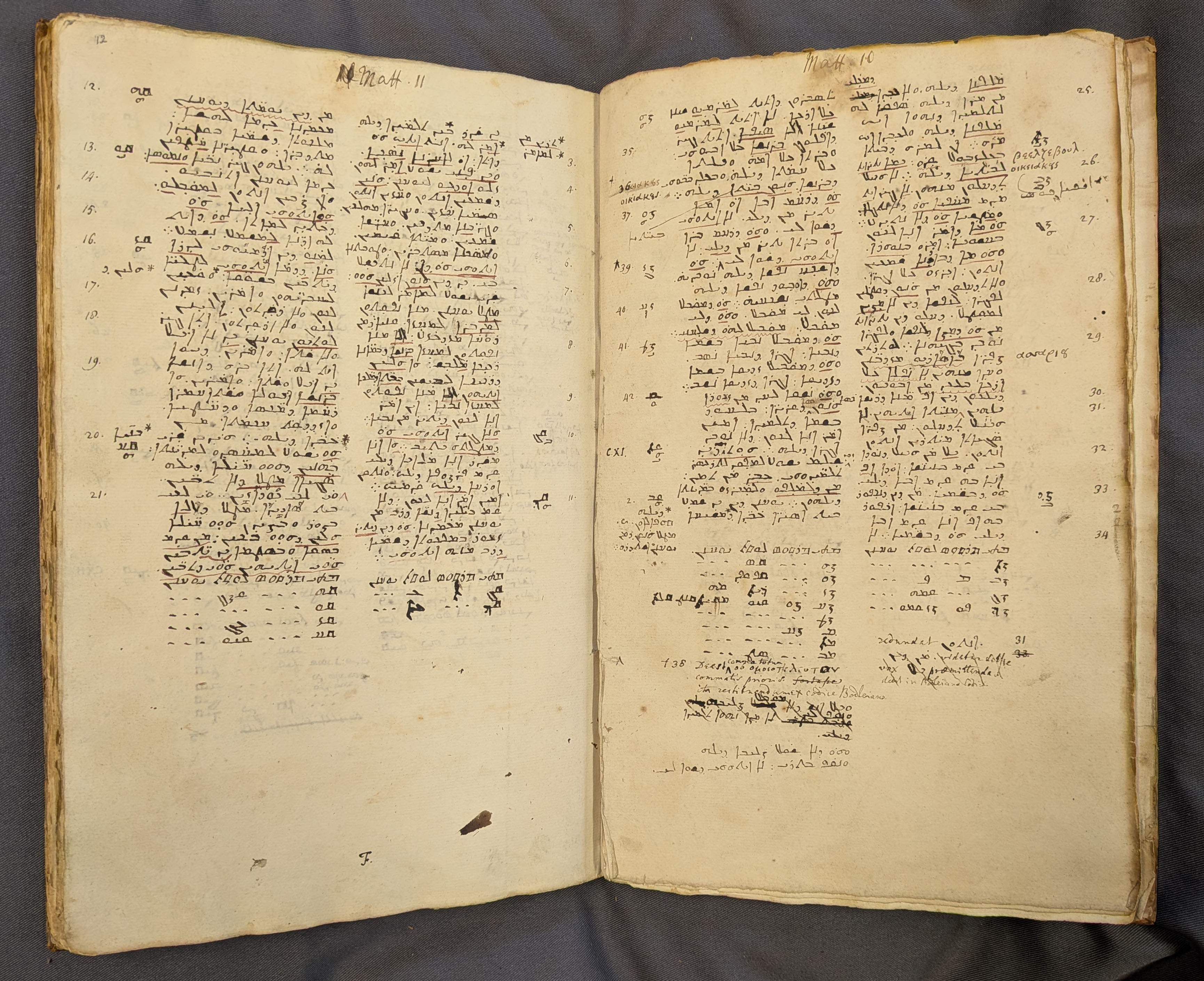
The opening above shows two example pages from the Gospel of Matthew. Although originally written in Greek—a language widely understood in the Levant—it is not surprising to find a Syriac translation. Firstly, Syria was a leading Greek speaking region in the Levant in the first centuries CE, so the original Greek text was translated into Syriac at an early stage. Secondly, Syriac is a dialect of Aramaic. As Aramaic was the language of both Jesus and many biblical figures, Christian communities in the Levant have always been interested in reading biblical texts in Syriac.
This manuscript is intriguing and is most definitely worthy of future research. Again, we are not precisely sure when this manuscript arrived at New College. The addition of titles in the Latin alphabet at the top of the page, listing the chapters of the gospel, suggest that it was used for intense Bible study. These titles are deliberate aids, helping the reader unfamiliar with the Syriac language to find the relevant part of the text.
Taken together, these three manuscripts show sustained interest in the Syriac language at New College.
Inspired first by the research of one fellow, Glocester Ridley, there was clearly a desire in college to collect and read biblical texts in as wide a range of languages as possible, including Syriac. As we will see on the next and final tab in our exhibition, this interest was by no means limited to texts written in Arabic, Hebrew, and Syriac—most evident in the college’s collection of beautifully printed polyglot bibles and in books written in a range of other languages.

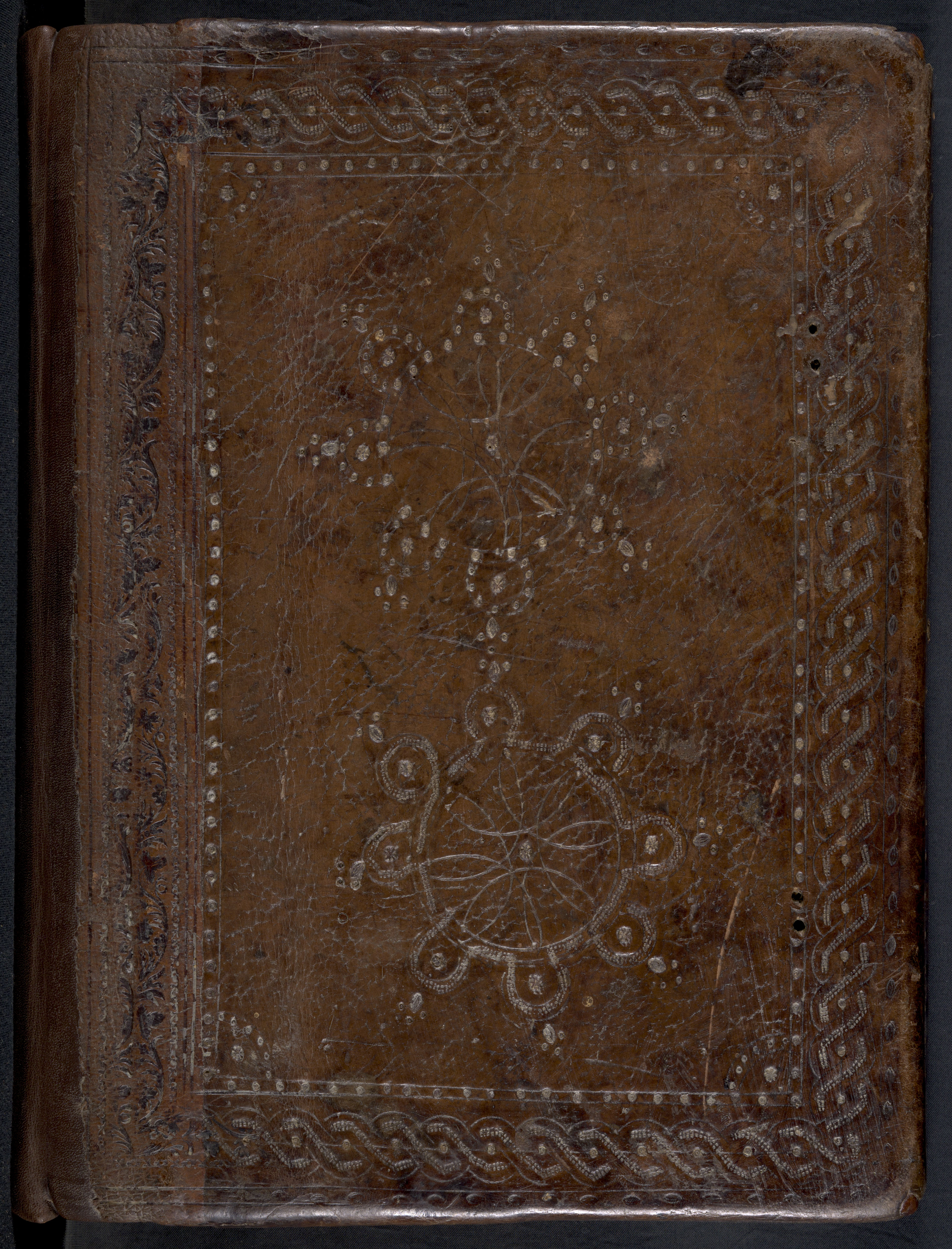 To begin with, we focus on MS 333. One of the oldest manuscripts in New College Library’s collections—possibly dating from the 11th century—this manuscript is a Syriac version of the New Testament. Here, you can see its beautiful and intricately decorated binding.