New College is among the oldest and largest constituent colleges of the University of Oxford.


New College was founded in 1379 by William of Wykeham (d. 1404), the bishop of Winchester. Officially named ‘The College of St Mary of Winchester in Oxford’, it quickly acquired the much snappier nickname “New College” as the most recent addition to Oxford’s academic landscape and to distinguish it from Oriel College, which was also dedicated to the Virgin Mary. A welcoming and thriving centre of learning, New College remains to this day a testament to Wykeham’s success as a politician, a prelate, and an educational pioneer.

Who was William of Wykeham?


Born in Hampshire in 1324 into a farming family, William of Wykeham rose rapidly through the ranks of English society during the reign of King Edward III to become one of the richest and most powerful men in the Church and court. After performing various administrative and quasi-legal roles in the royal employ, he was made the King’s principal secretary in 1361, the Keeper of the Privy Seal in 1363, and eventually Chancellor of England in 1366.

Wykeham was ordained in 1361 and elected bishop of Winchester—one of the wealthiest bishoprics in Christendom—in 1366. Wykeham held lots of other offices in the church (also called benefices) at the same time, from which he derived a considerable income.

In the late summer of 1376, however, Wykeham fell dramatically out of royal favour. He was accused of various offences and abuses of power by the king’s son, John of Gaunt, and his followers. Wykeham was ultimately restored to the bishopric of Winchester on 21 June 1377—three days before Edward III’s death—and pardoned by the young King Richard II a few weeks later. He continued to be an active and powerful force in English politics throughout Richard II’s turbulent reign, until ill health required him to withdraw from public life. William of Wykeham died on 27 September 1404 at the age of 80.

Wykeham is perhaps best remembered today, however, as the founder of two prestigious educational establishments—New College, Oxford, and its feeder school, Winchester College.

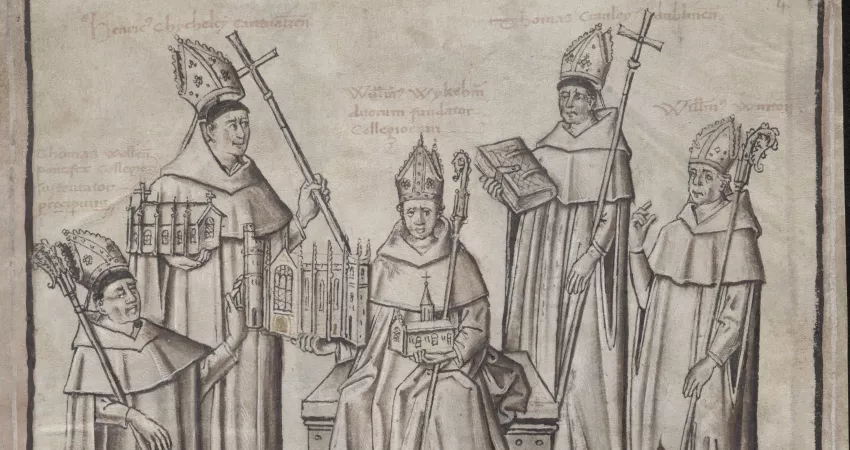
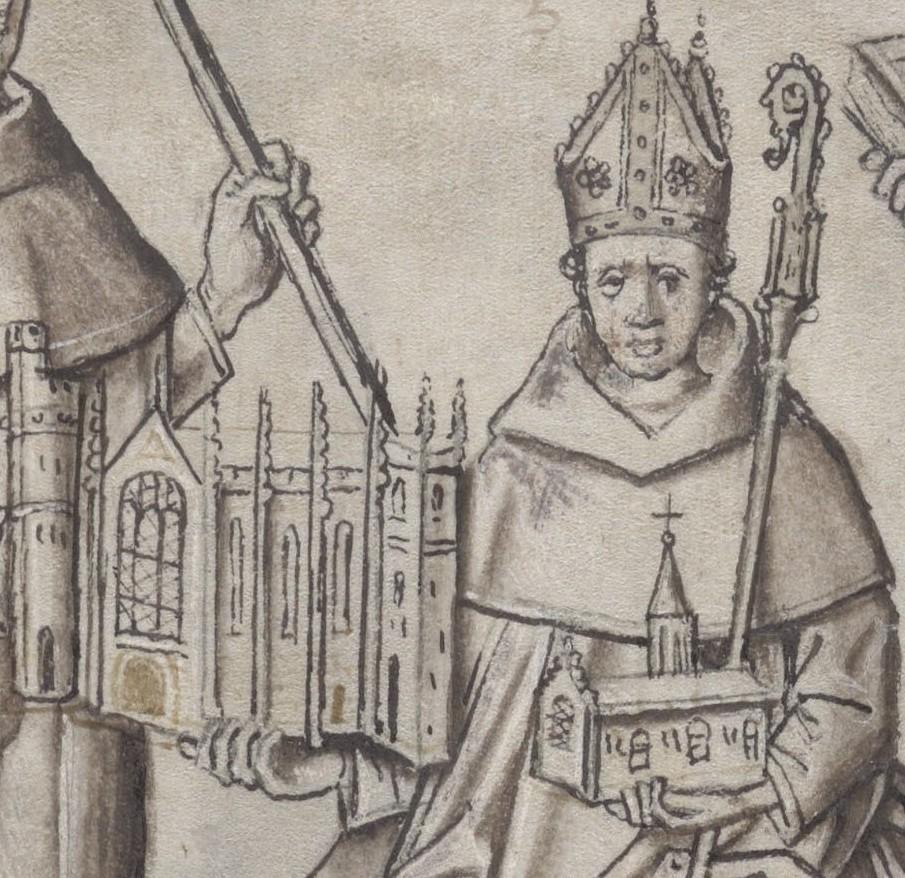
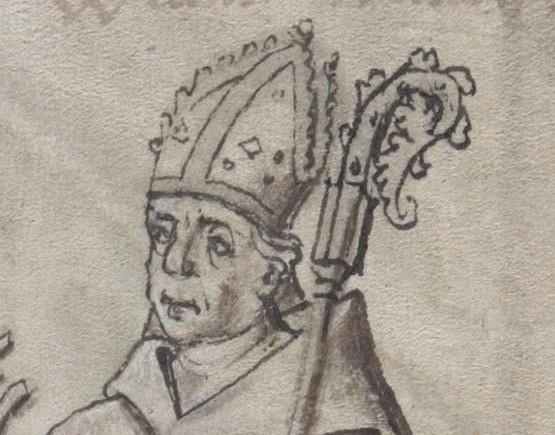
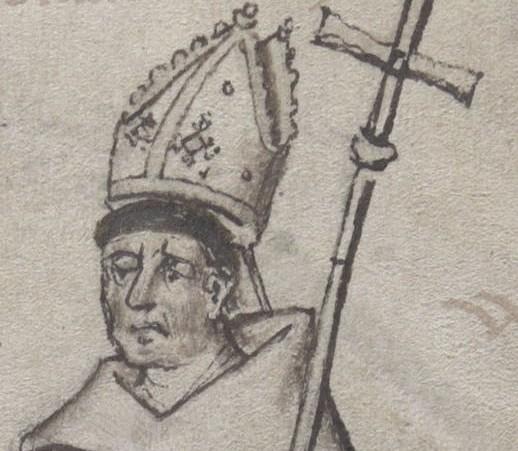
Detail of New College, Oxford, MS 288, f. 4r. This image shows William of Wykeham, the founder of New College, surrounded by four of its most famous benefactors and alumni. Image drawn in pen and ink.
Image

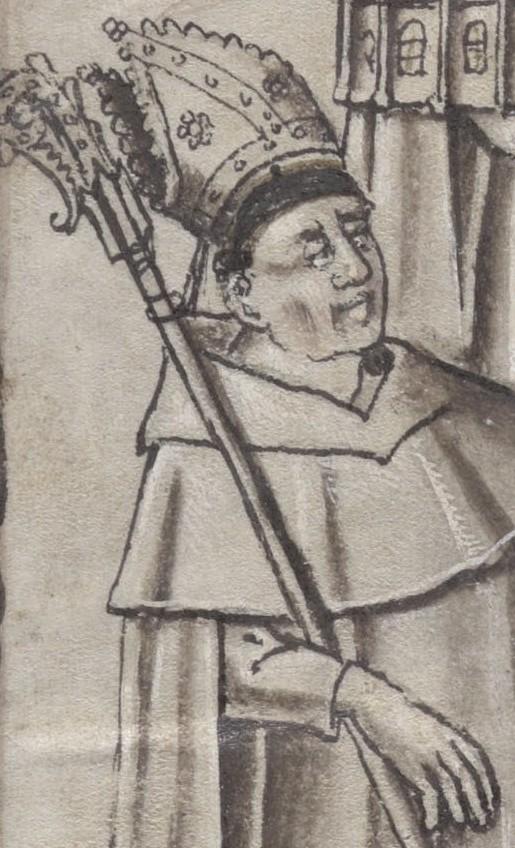
This is Thomas Beckington (d. 1465). He was the bishop of Bath and Wells and the King's secretary. Beckington is described here as ‘the main supporter of the college’ (Collegio sustentator precipuus).

Image

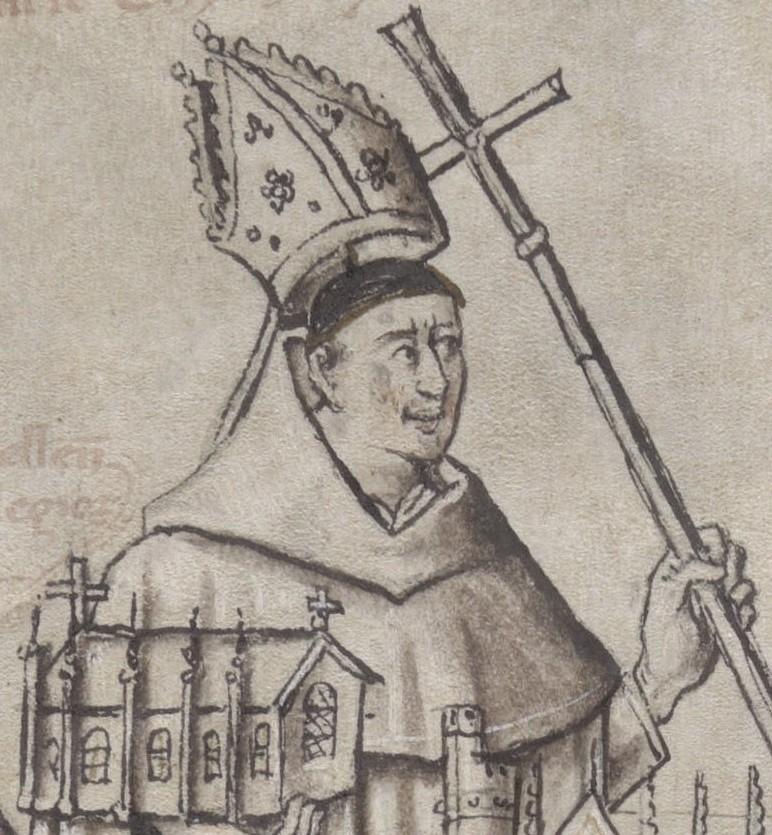
This is Henry Chichele (d. 1443), archbishop of Canterbury and founder of All Souls College, Oxford. He is shown here holding a model of his own college chapel.

Image

William of Wykeham (d. 1404), bishop of Winchester and founder of New College, Oxford and Winchester College. He holds a model of New College’s chapel and Bell Tower in his right hand and a model of Winchester College chapel in his left hand.

Image

This is William Waynflete (d. 1486). He was the bishop of Winchester and founder of Magdalen College, Oxford.

Image

This is Thomas Cranley (d. 1417). He was Archbishop of Dublin and the first warden of Winchester College—New College’s feeder school .

×

In the picture above, from the college’s MS 288, Wykeham is shown surrounded by some of the most famous alumni and benefactors of his colleges. Click on the individuals to identify them.  

To learn more about this manuscript, keep reading below. 

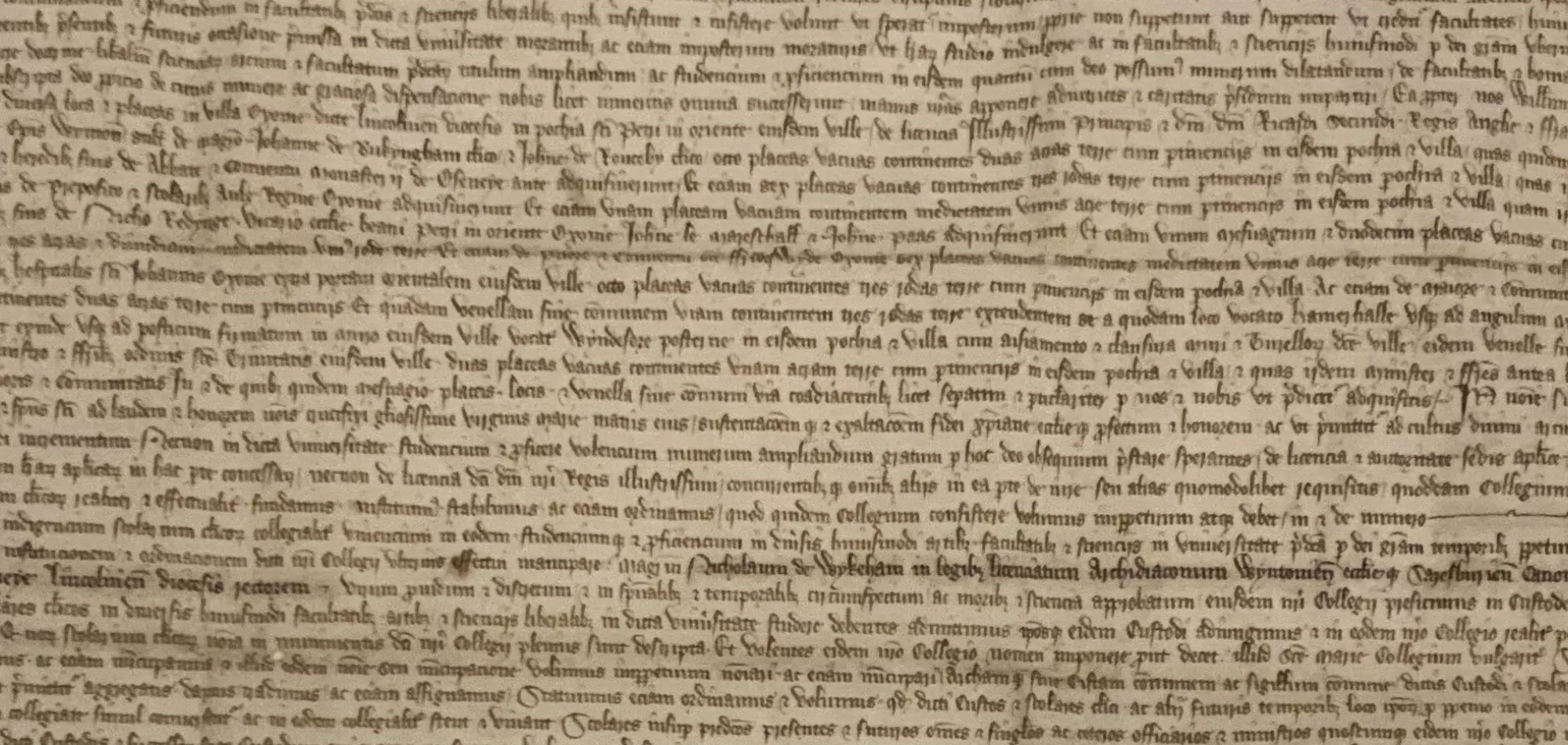
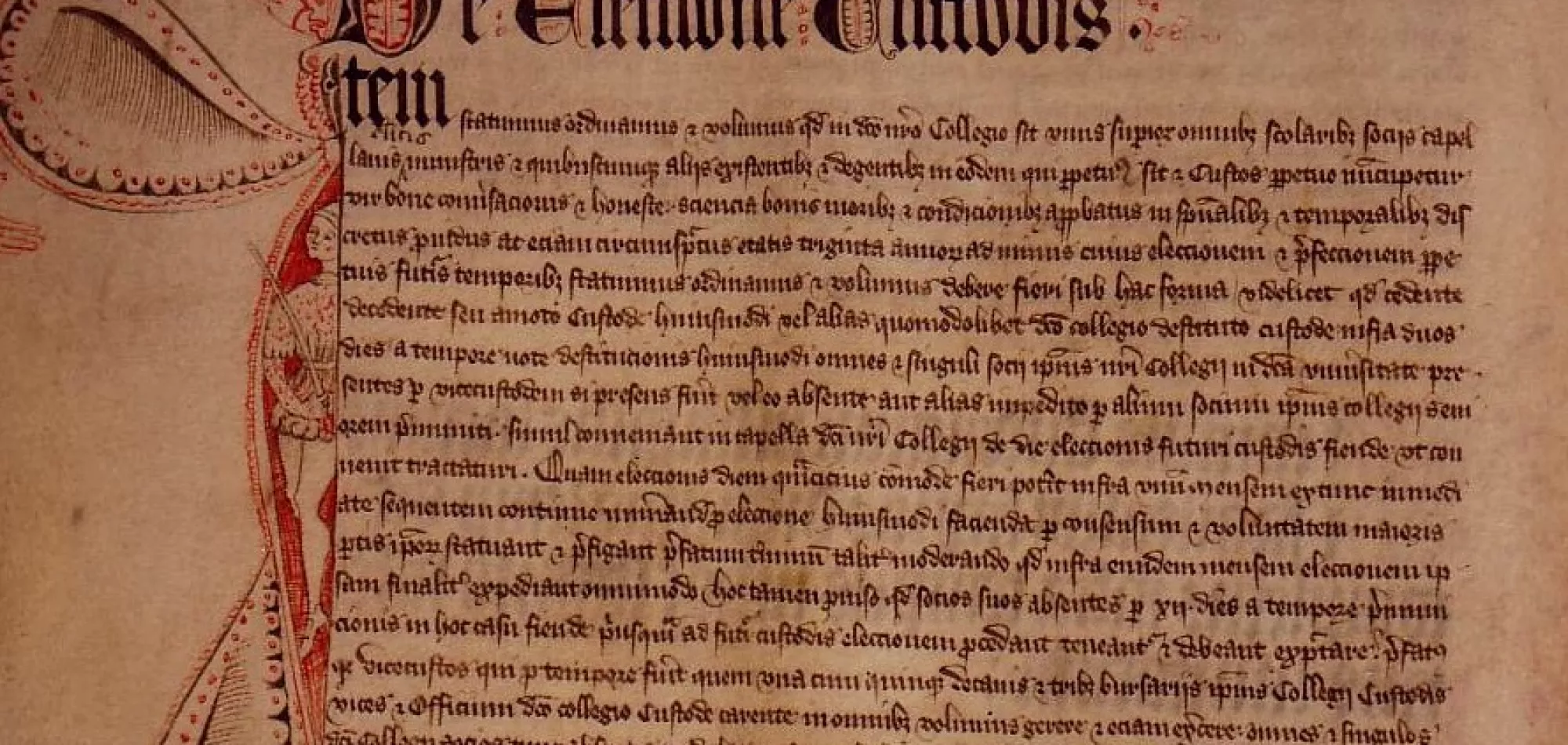
A handwritten charter.

Wykeham’s Vision


New College was formally founded on 26 November 1379. 

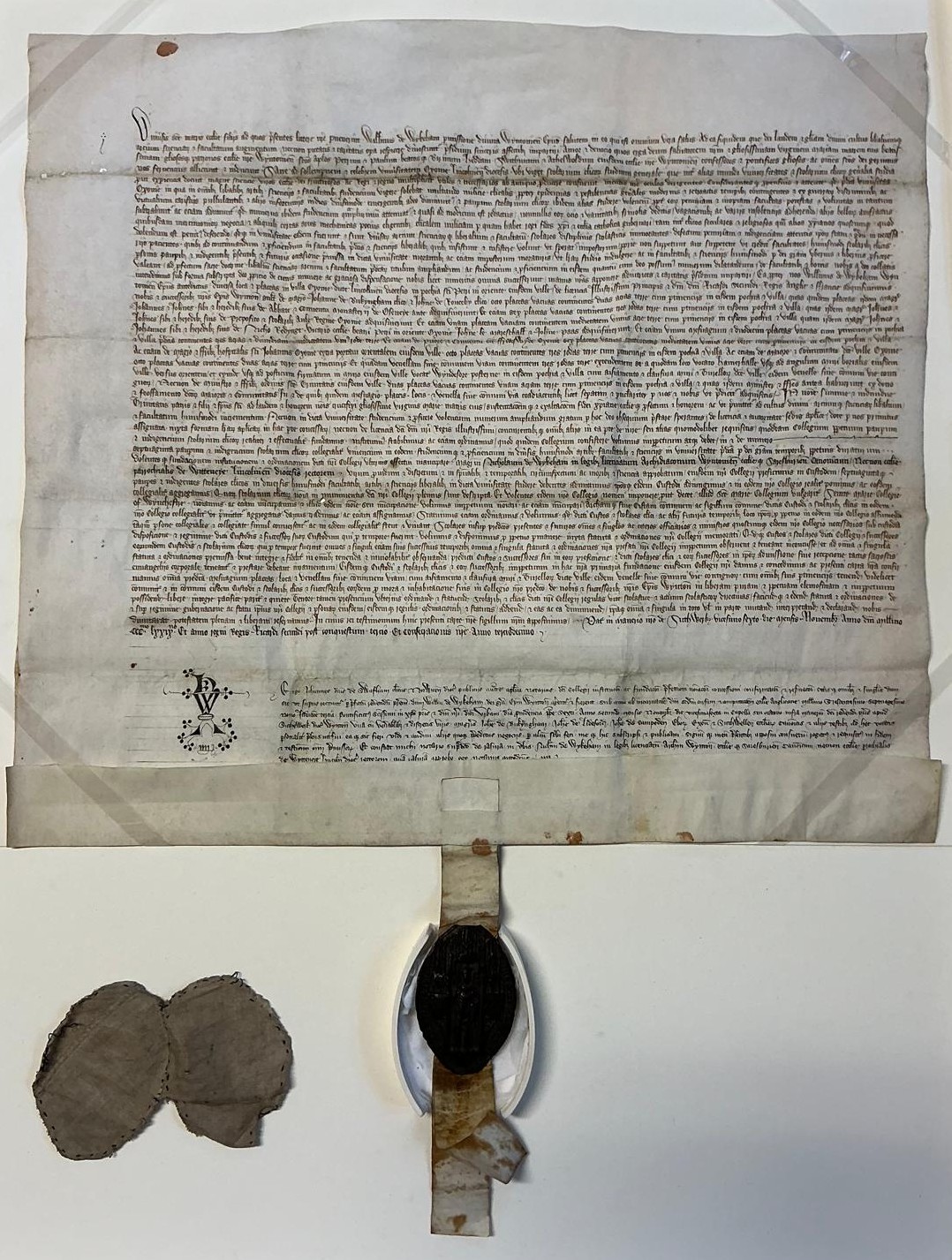
Its foundation charter (New College Archives, Oxford, NCA 12415) is a long and detailed document written in Latin (pictured here). It tells us lots about Wykeham’s vision and his motivations for founding the college. 

 A handwritten charterThe charter shows that Wykeham was deeply concerned that there were not enough secular clergy in England. Secular clergy were deacons and priests not under monastic vows who served the everyday needs of the people in their parish. In his foundation charter for New College, Wykeham explained that plagues and pestilences (such as the Black Death), wars, and food shortages had drastically reduced their numbers. He also reported that many potential clerical students were choosing instead to get married or pursue careers in the military, trades, or industry. Consequently, Wykeham wanted to educate and train a new generation of secular clergy at his college to administer to the spiritual needs of the population and help defend and enhance the Christian faith in England. 

Wykeham explained in the foundation charter that he had chosen to set up his college in Oxford because the University had an established reputation for producing ‘great men of science’ (‘magni scientiae viri’) who went on to serve the Church and realm. Wykeham wanted to re-invigorate clerical studies in Oxford and provide for the education of ‘poor and needy‘ (‘pauperes et indigentes’) scholars there.  

Wykeham invested considerable time, money, and effort into planning what was to be the largest and wealthiest college in Oxford at the time of its foundation. The foundation charter contains a long list of lands and properties which Wykeham acquired in the city to endow his college and to support its construction. Wykeham made provision for 70 fellows, almost doubling the number of college fellows in Oxford at the time. He specified that his relative, Nicholas of Wykeham, would be its first warden (the head of college) and that the college would be governed by statutes which all members must swear to observe upon admittance (see below). 

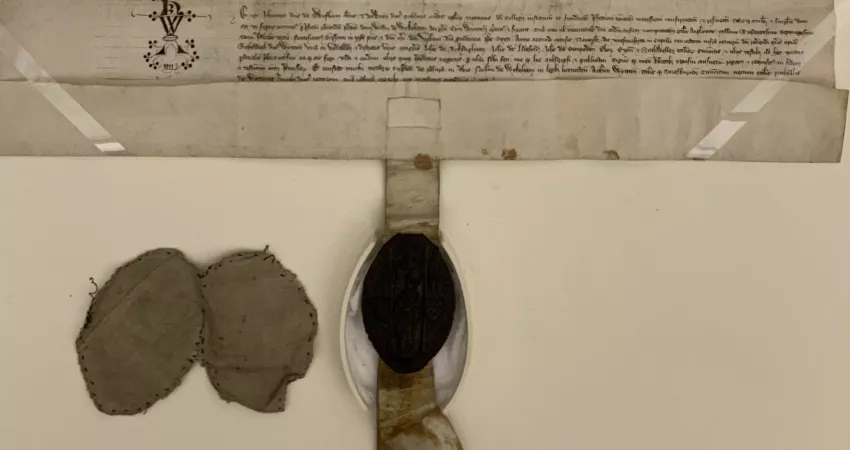
Notarial attestation and seal of New College Archives, Oxford, NCA 12415.
Image

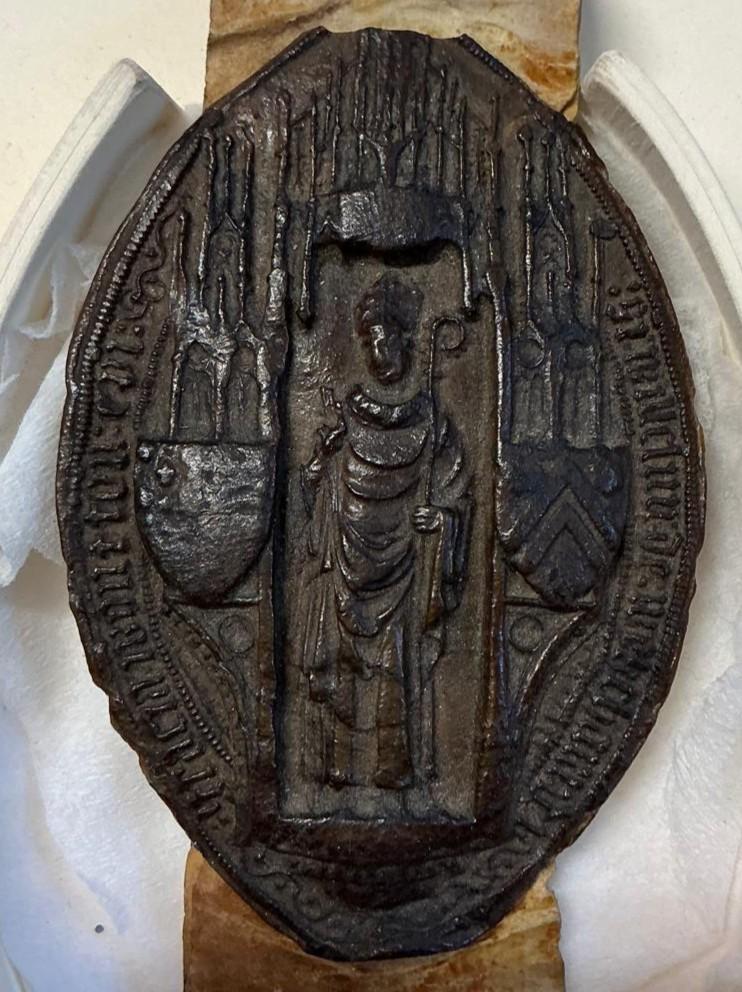
This image shows the detail of William of Wykeham’s seal. You can clearly see his coat of arms on his left, which remain the arms of New College to this day.

×

At the bottom of the charter, beneath the main portion of the text, is a statement by the notary public—a scribe who had been licensed by the pope to authenticate documents. His name was Iohannes dictus de Swafham. On the left of his statement, John also provided his unique notarial mark, further authenticating the document.

William of Wykeham added his seal to the foundation charter. It has been perfectly preserved in a cloth bag. It shows Wykeham in his bishop’s dress, wearing his mitre (bishop’s hat), and holding his crosier (hooked staff). To the right of Wykeham is his coat of arms—two chevronels between three roses—which remain the arms of New College to this day.

Test Your Knowledge: When did William of Wykeham found New College?

Statues in front quad

In which of the years below was the college founded? Click on the years to find out if you’re right!

1324

Nope, try again . . .

1379

Yes, correct!

1456

Nope, try again . . .

A page from a copy of William of Wykeham’s statutes for New College (New College, Oxford, NCA 3584).

Wykeham’s Rules


Wykeham wrote extensive, meticulous statutes to govern activities at New College, both at an institutional and an individual level. Though he drew inspiration from the statutes of other Oxford colleges, such as Merton College and The Queen’s College, his rules stand out for their sheer comprehensiveness. No detail was too small for Wykeham, who considered everything from the layout of the fellows’ chambers to the entertainment allowed at feast days and the times when the college gate should be closed.

The statutes survive in several copies dating from the late-fourteenth century. Some have been extensively annotated and others contain copies of injunctions made by later visitors. The images below come from a copy in the college’s archives which preserves the least authoritative text, but the most excellent illustrations (NCA 3584). 

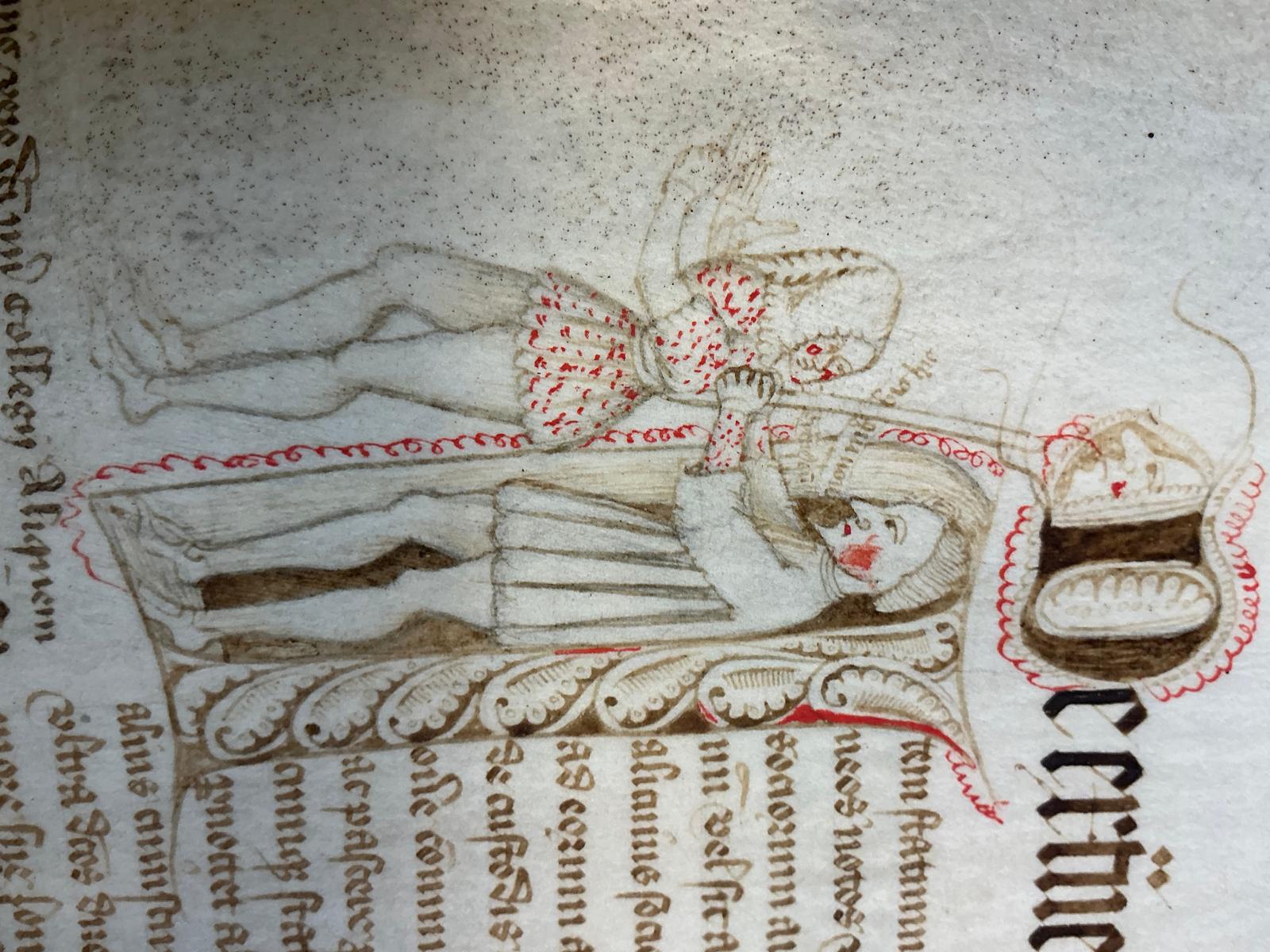
An initial “I” which is partly formed of a brown and red ink drawing of a college porter pushing another individual out of a door.

Through the college statutes, Wykeham sought to enforce strict codes of behaviour on its members. Of the 70 fellows, 20 were permitted to read law. Two could study medicine and two astronomy, but the rest were required to read theology. Bickering and quarrels were forbidden, as was the owning of hawks, falcons, hounds, and ferrets by any member of the college except the warden. Fellows were also prohibited from allowing “outsiders” into the college. In this copy of the statutes, this rule was illustrated by a college porter ejecting a local youth from the grounds (see image; NCA 3584, f. 11v)! The New College porters continue to provide vital services to this day—though rather less brusquely—including controlling access to college, and ensuring the safety and security of its students, staff, and visitors.

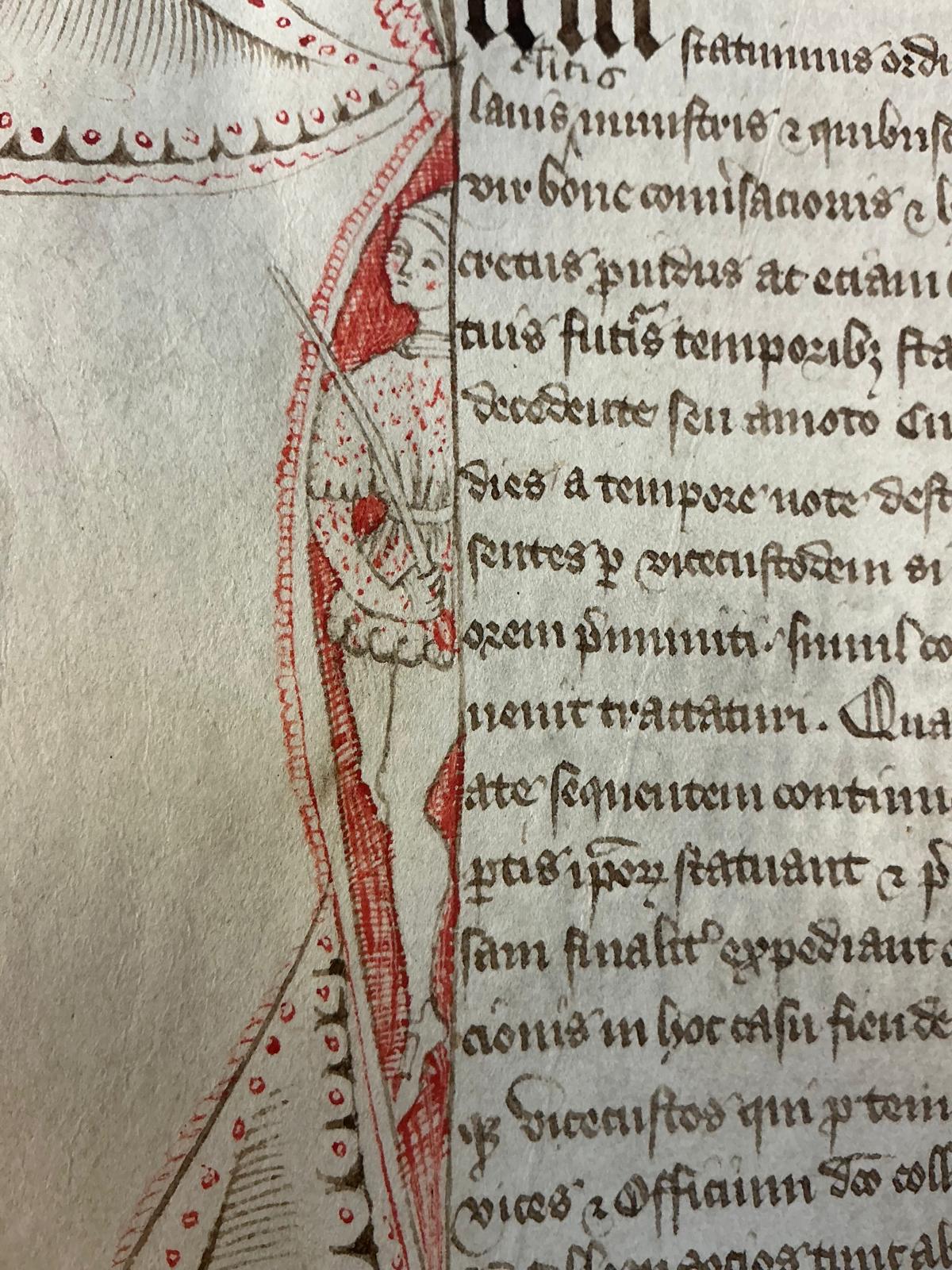
An initial “I” which is partly formed of a brown and red ink drawing of a fancily dressed individual wearing a cap and pointed shoes, and carrying a sword.

Wykeham also provided detailed information in the statutes about what the fellows and scholars at his college should, and should not, wear. He favoured simple attire to reflect the seriousness of study and issued specific injunctions against cloaks, colourful items of clothing, and belts and girdles ornamented with gold or silver. A drawing which decorates the opening of a different rule earlier in this copy of the statutes (NCA 3584, f. 6v) depicts a particularly flamboyantly dressed individual (see the image)—Wykeham would surely not have approved! 

The New College statutes also instituted a rigorous round of religious services and provided minute directions about prayer, both private and public. This reflected Wykeham’s desire for his college, in addition to providing highly educated men to enrich the body of secular clergy in England, to serve as an eternal chantry for his soul. The statutes outlined how the members of New College, led by its chaplaincy, would always pray for Wykeham, his patrons, and other college benefactors to ensure their souls a place in Heaven. New College was a choral foundation. In the statues, Wykeham provided for 10 chaplains, 3 clerks, and 16 choristers. Wykeham ordered that these members of the college should be retained even if its income failed. 
 

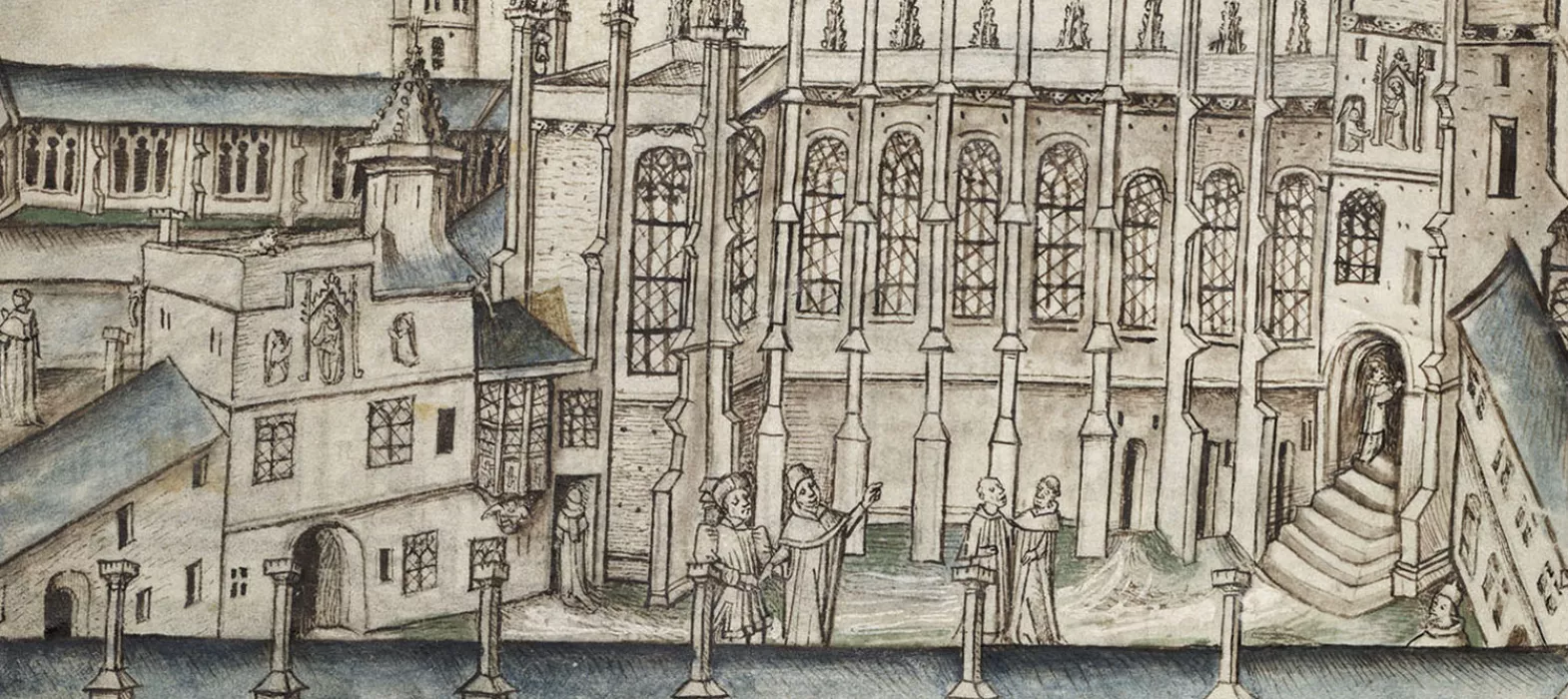
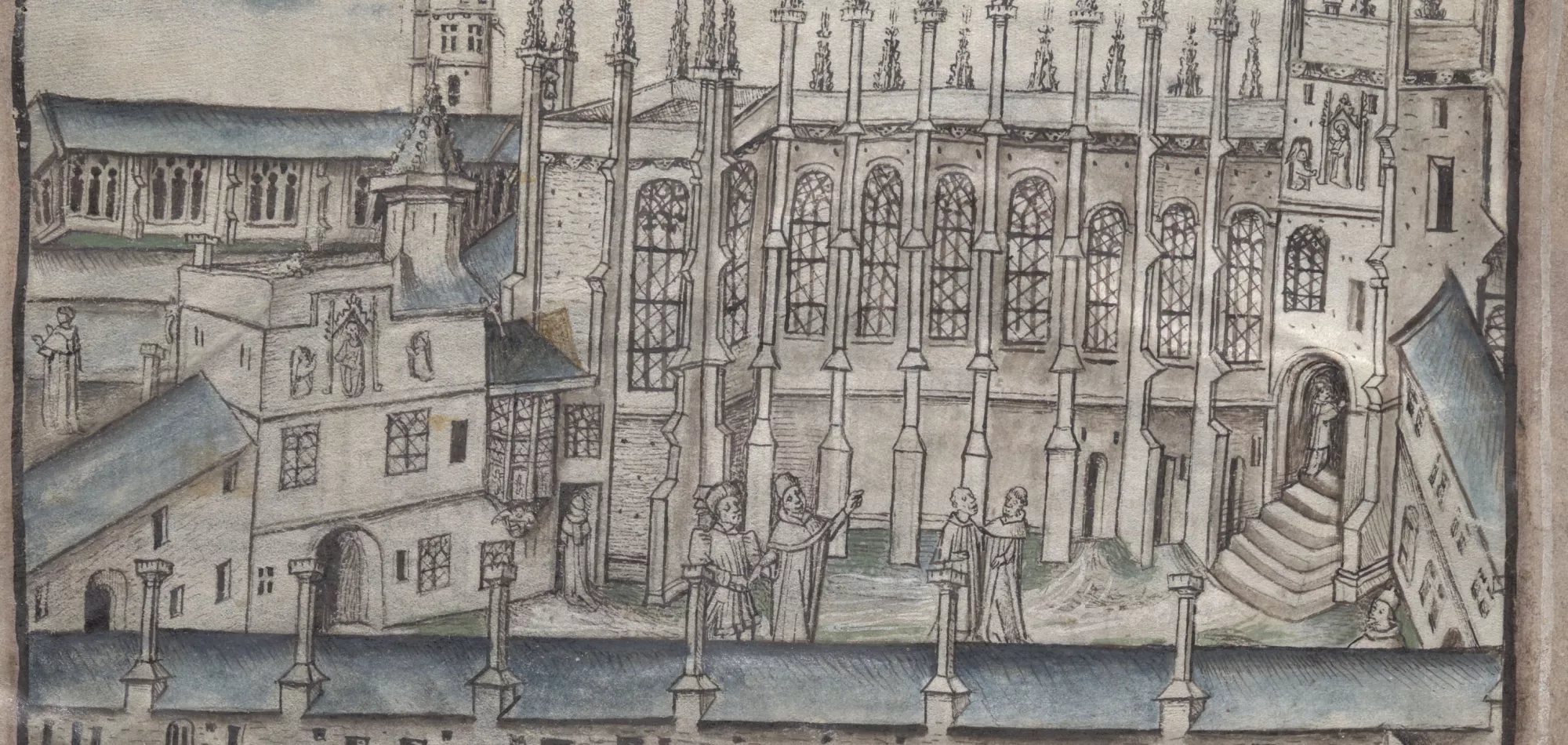
An image of the college’s front quad. This is a detail taken from New College, Oxford, MS 288, f. 3r.

Building the College


The architecture of New College is impressive, intentional, and novel. William of Wykeham wanted the buildings to be both functional and beautiful, testifying to the glory of God. He employed the master mason William Wynford and his team, with whom he had worked when Clerk of Works at Windsor Castle in the 1350s, carefully to design and construct a series of large and imposing structures skilfully decorated with sculpture and glass. Wykeham was the first founder to provide all the elements of a college in one design, including a chapel, a hall, accommodation for the warden and the fellows, a library, an administrative centre (the bursary), a secure store for valuable items and documents (the muniment tower), a kitchen, and—perhaps most importantly—a loo! 

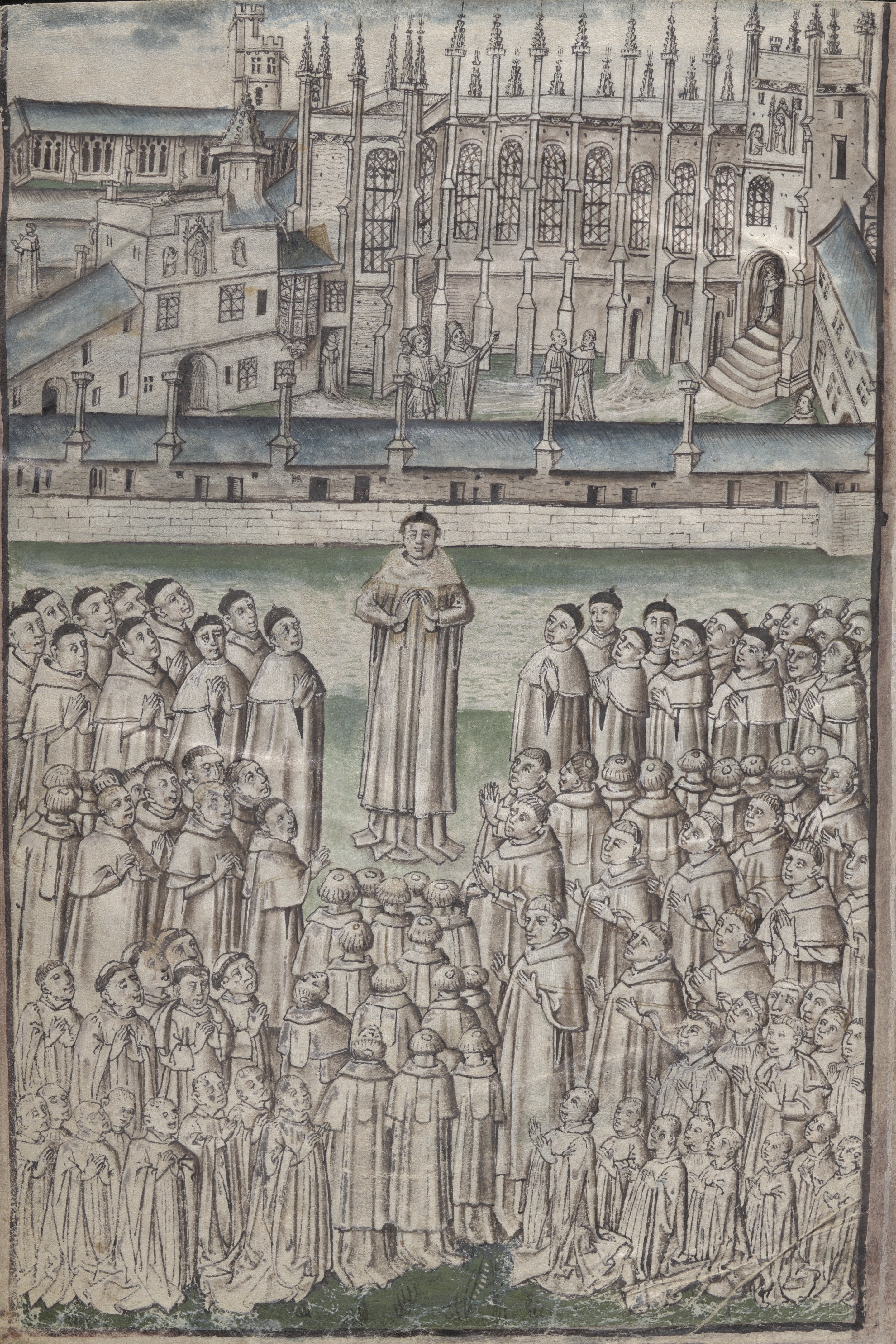
New College, Oxford, MS 244, f. 4r. An image depicting the New College front quad in the background and the warden surrounded by members of the college in the foreground.This image of New College is found in the library’s MS 288. Today, it is known as the Chaundler Manuscript because it contains texts authored by Thomas Chaundler—sometime chancellor of Oxford and warden of New College—including verse and prose accounts of Wykeham’s life. 

In the foreground, the warden stands surrounded by various members of the college, ranging from graduate students to choristers. In the background, New College is depicted. 

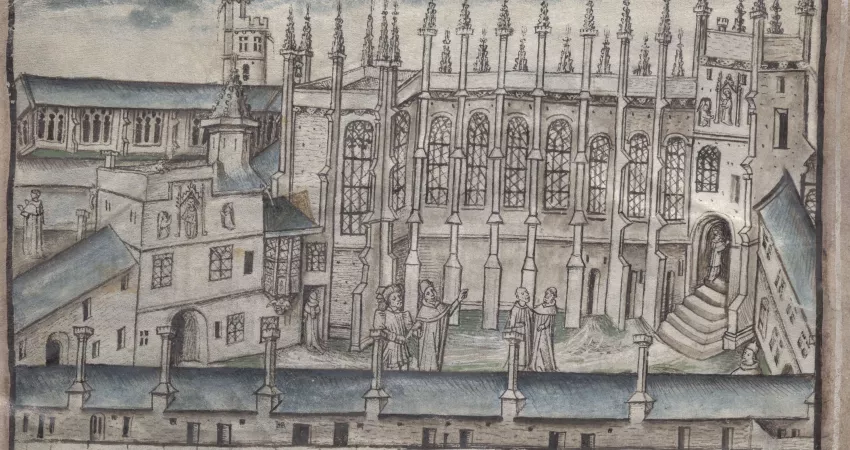
The drawing shows the Front Quad, viewed from the south, with the slightly later Cloisters and Bell Tower behind and to the left. This is the earliest topographically accurate representation of New College. 

The Front Quad was the heart of the college. It foundation stone was laid in March 1380, and it was completed for occupation in 1386. It was the largest building erected in Oxford since the 12th century and the first closed quadrangle ever built in the city. This design was subsequently emulated by many other colleges in Oxford and Cambridge. 

The buildings in the Front Quad shown are still instantly recognisable today, as you can see more clearly in the zoomed-in image below. 

Detail of New College, Oxford, MS 288, f. 3r, showing the drawing of the college’s front quad.
Image

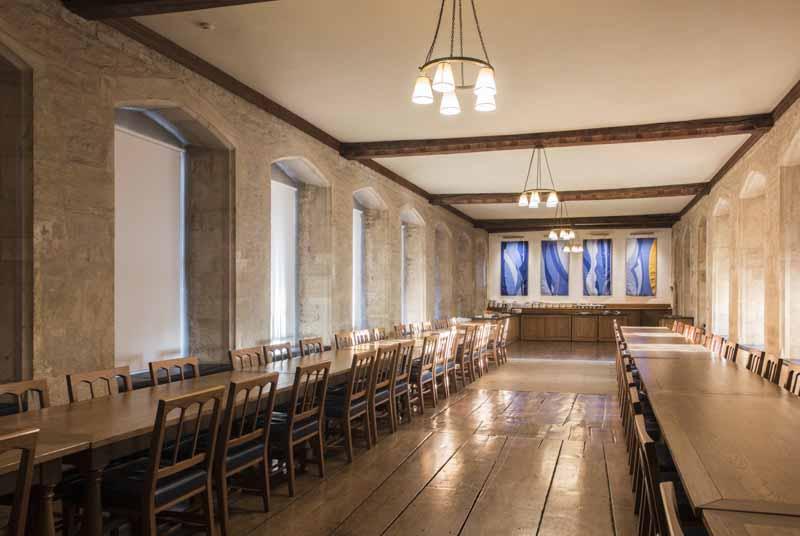
New College was the first Oxford or Cambridge college to have a library as an integral part of its design. Built on the first floor to protect its contents from flooding and damp, with thick walls to guard against fire, it is now the SCR dining hall.

Image

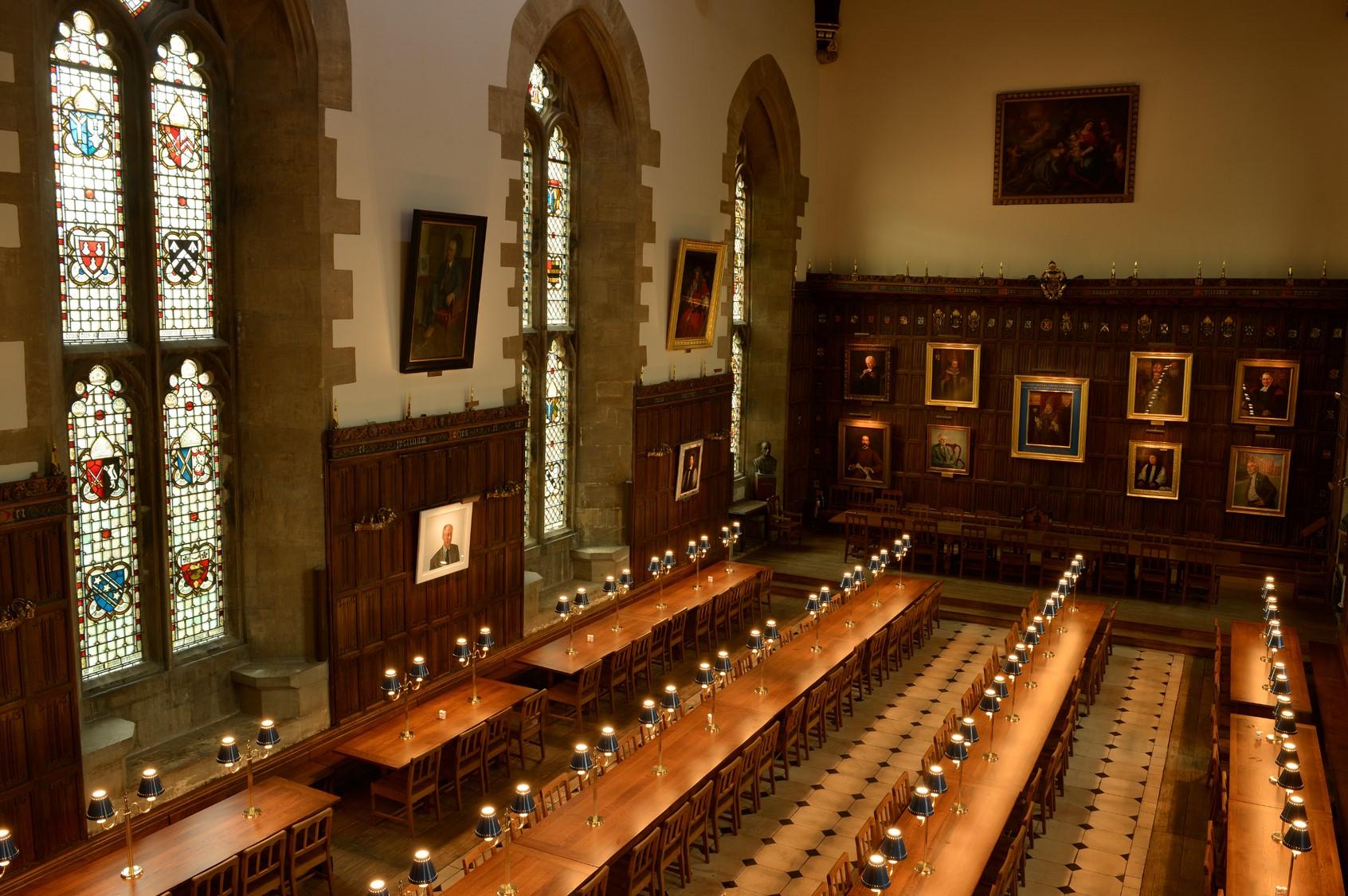
Hall is where college staff and students gather to enjoy delicious meals prepared and served by the Buttery (kitchen) staff. An immense and impressive structure, it is the oldest and tallest college hall in Oxford or Cambridge.

Image

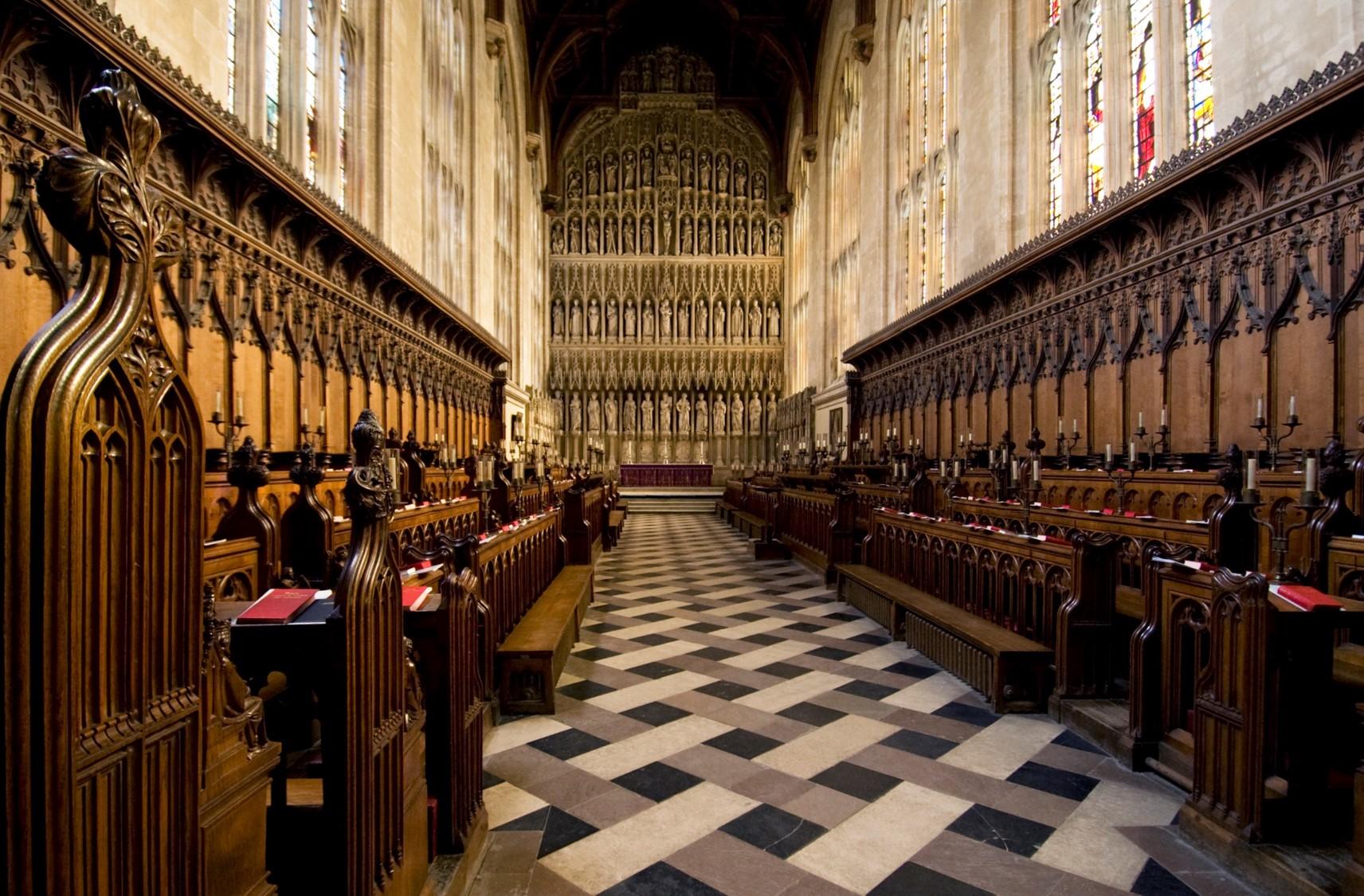
The Chapel was conceived as one of the college’s core buildings from the outset. The devotional regimen at New College was more involved than at other colleges.

Image

William of Wykeham designed the Muniment Tower to store securely the college’s records and plate. It still performs this vital function today. Here is our archivist hard at work in the Muniment Tower!

Image

Today, the New College Lane gatehouse serves as the visitor entrance to college. However, it was the front entrance until 1983. The Warden’s Lodgings are located above the gateway, allowing the warden to keep an eye on those coming in and out of college.

Image

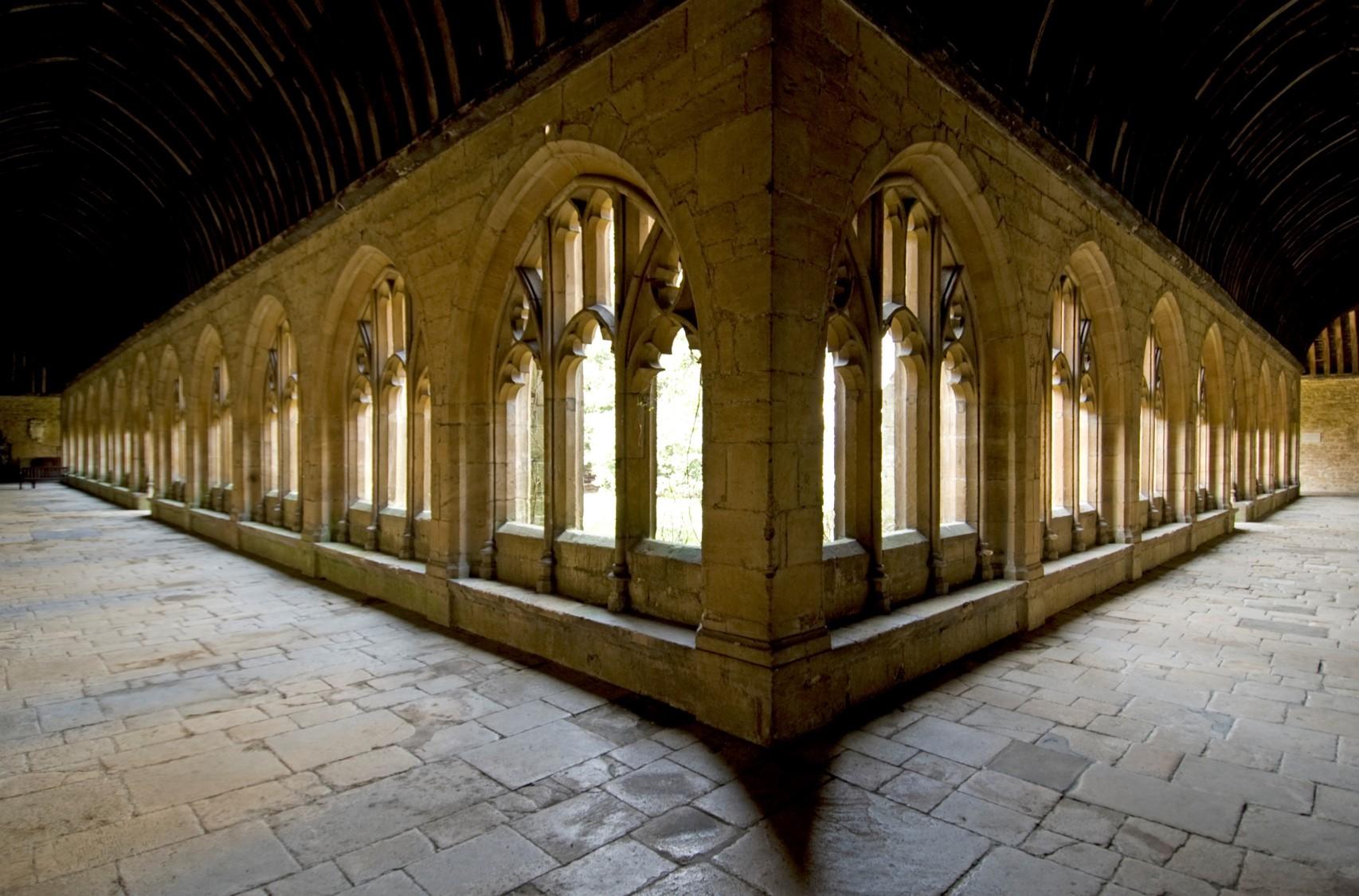
Land west of the chapel was purchased in 1389, and New College Lane diverted, to allow for the construction of a cloister—a covered walkway around a courtyard frequently found in monasteries and churches.

Image

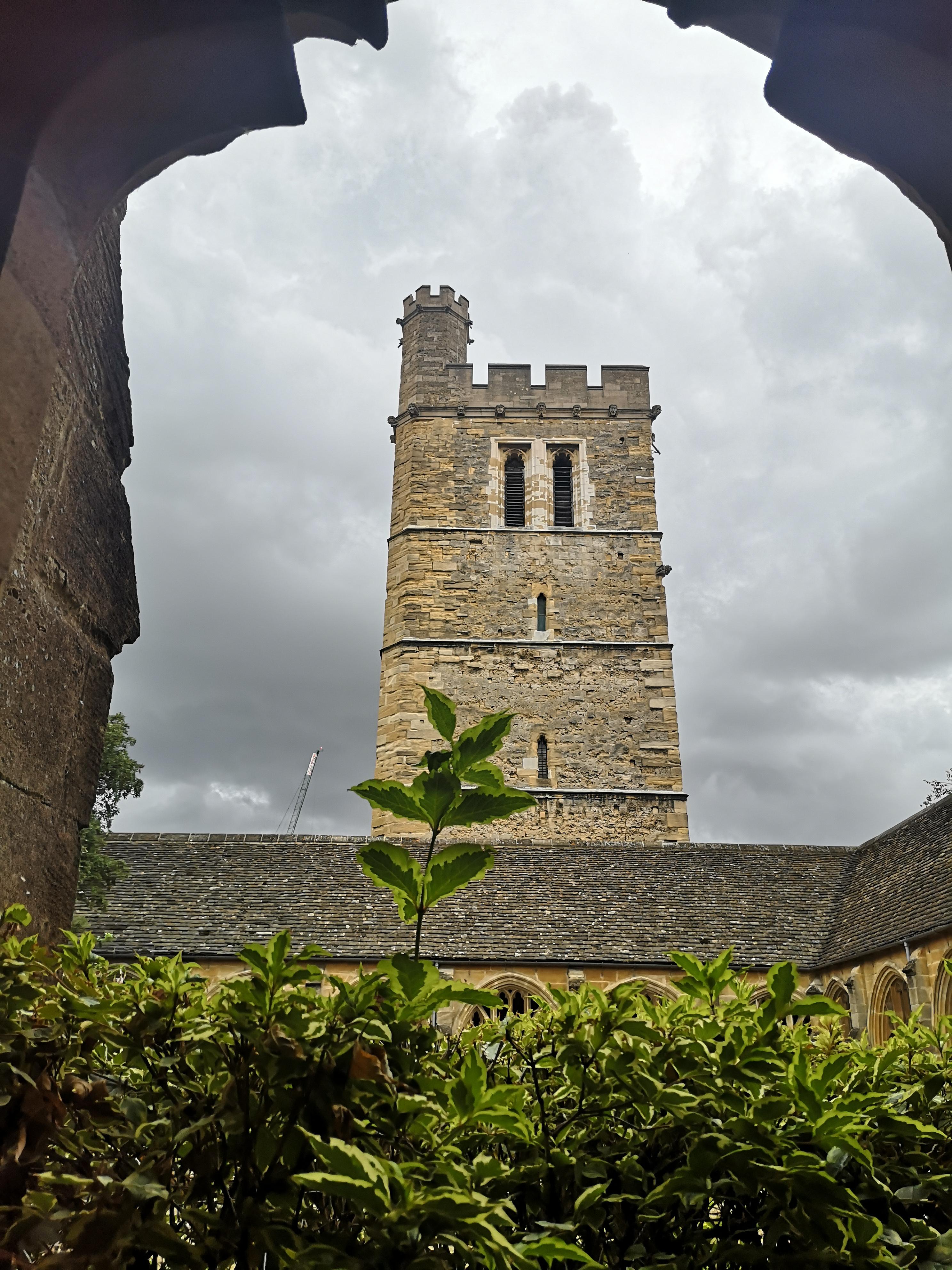
Forming part of the Cloister, the Bell Tower was completed in 1403. Today, members of college can climb to the top of the tower for stunning views over central Oxford, taking in the Radcliffe Camera, Duke Humphrey’s Library, and the Sheldonian Theatre.

Image

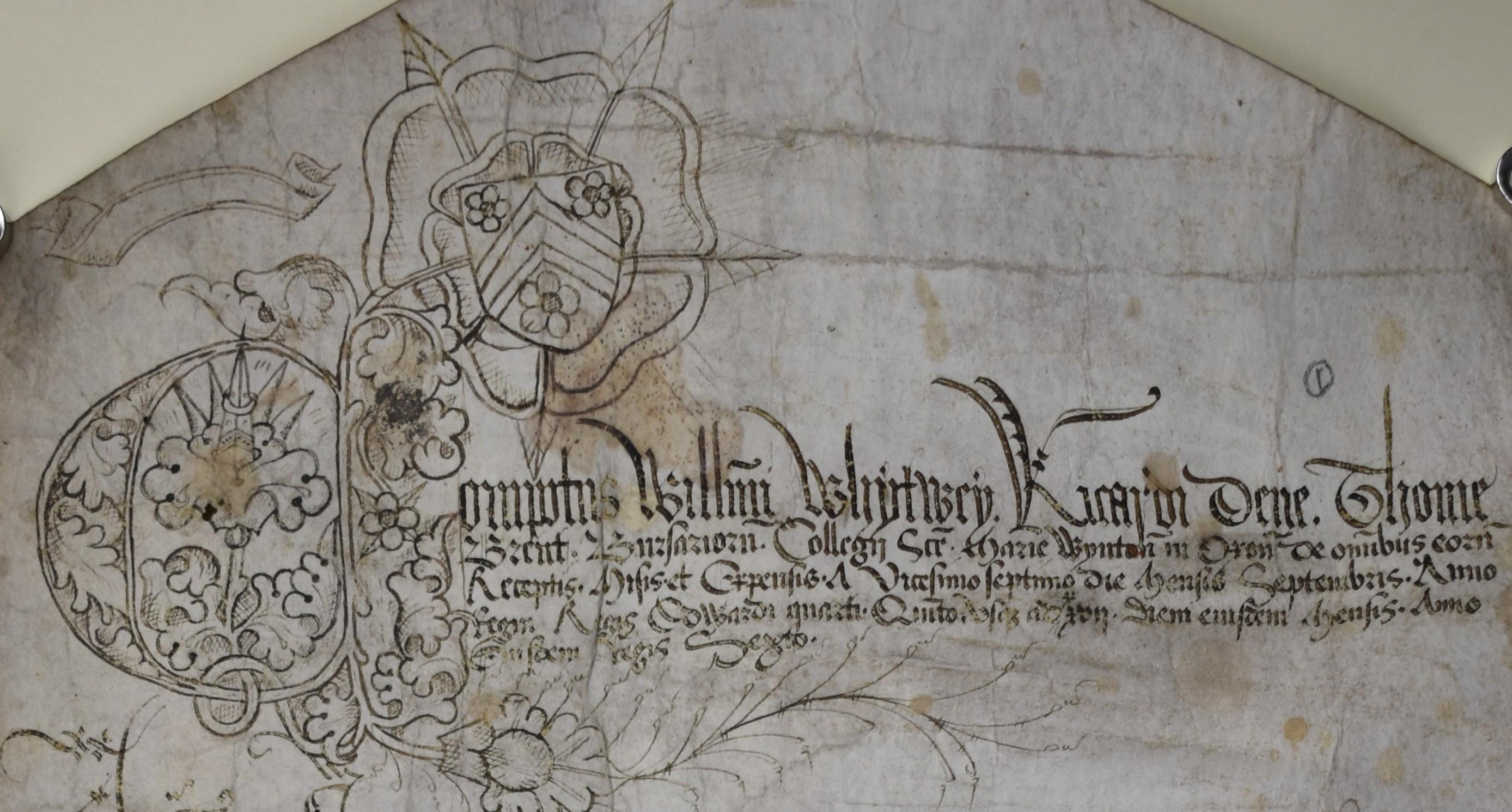
The Bursary was the office of the Bursars—the senior administrative officers responsible for the college’s finances. Pictured here is the heading from a Bursars’ Account Roll from 1484–5 showing the college coat of arms (New College, Oxford, NCA 7718)

Image

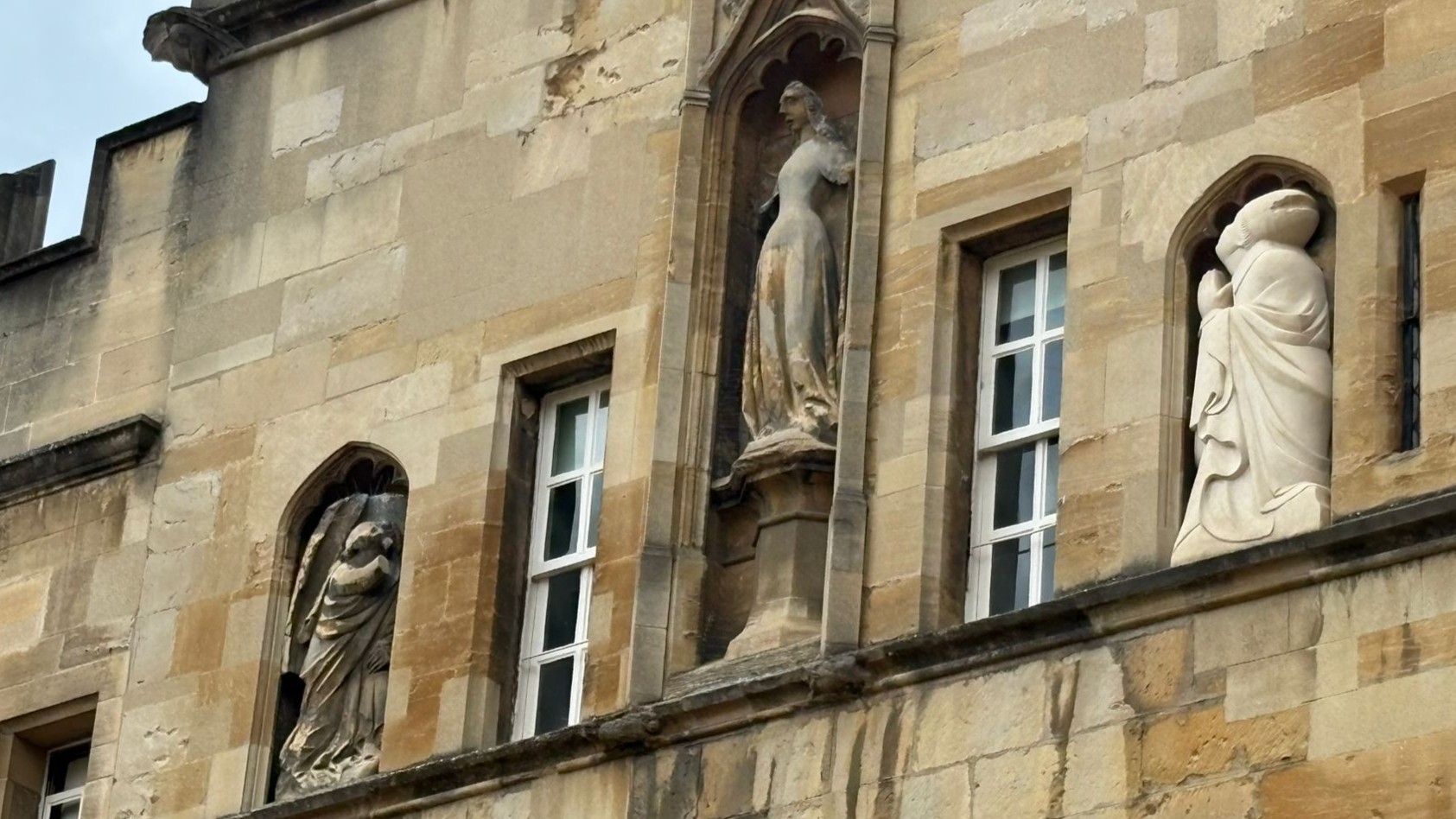
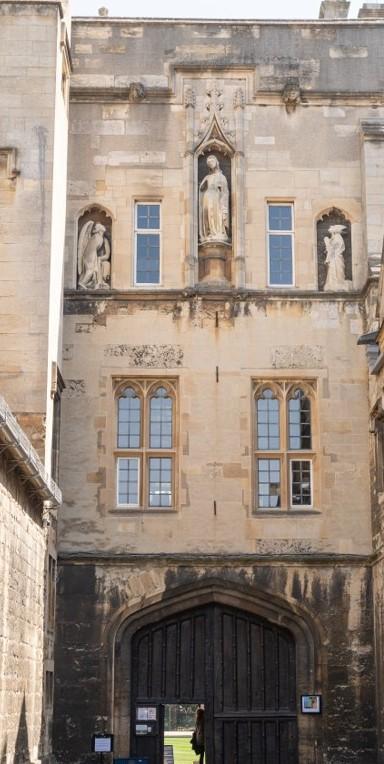
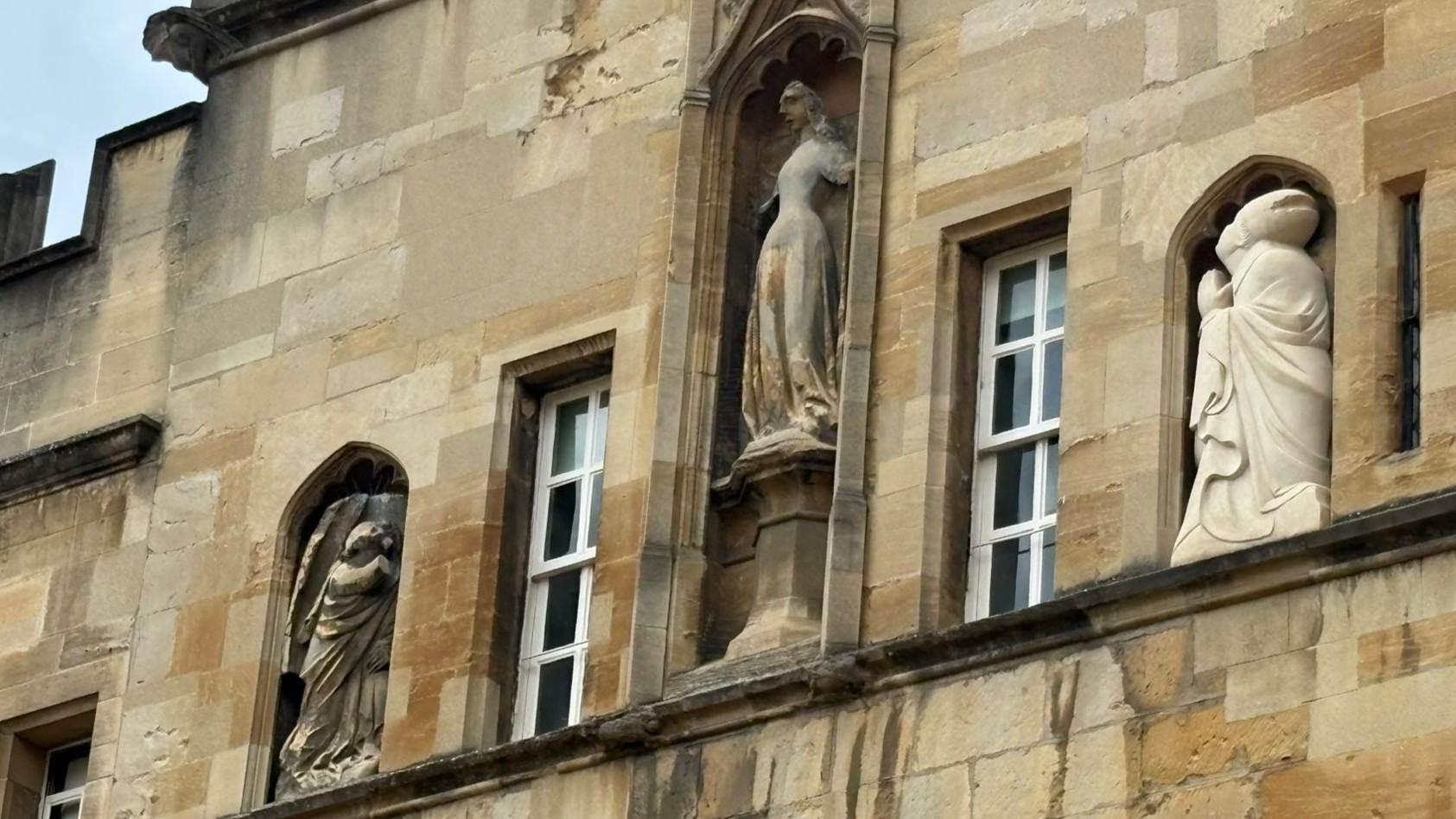
These statues depict William of Wykeham, the Virgin Mary—the college dedicatee—and the Archangel Gabriel. They are mirrored on the other side of the gatehouse and on the Muniment Tower. Consequently, the fellows were rarely out of their sight!

×

 Click on different parts of the image of the front quad above to learn more about them. 

Detail of a handwritten charter (New College, Oxford, MS 13152)

Planning for the Future


William of Wykeham gave his college significant tranches of land and money to secure its future. Applying his considerable administrative acumen and keen eye for a good deal, he strategically acquired properties to fund the building and endowment of his college.

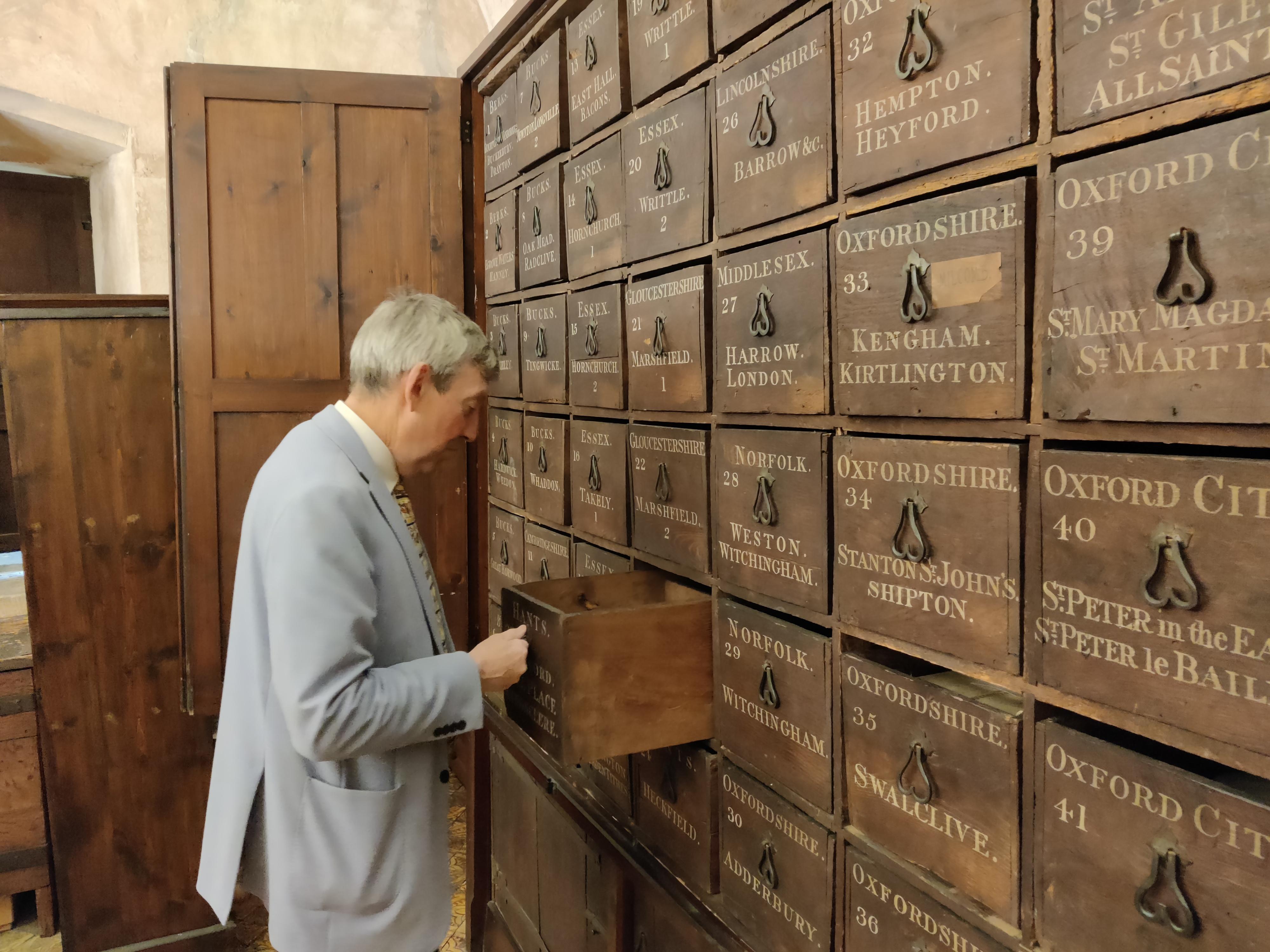
During his lifetime, Wykeham gave 22 manors to the college. Most of these were in Berkshire, Buckinghamshire, Essex, Oxfordshire, and Wiltshire. From these properties, the college could derive income by charging rent and receiving other revenues. In the college statutes, he stipulated that stewards and bailiffs should be appointed to work under the bursars, collecting rent and supervising any expenditure required of the college as a landlord.

When Wykeham purchased these lands for New College, he also acquired the documents which came with them. Consequently, the college’s archives are full of charters, deeds, court and account rolls relating to its properties. Many of these documents are even older than the college itself! 
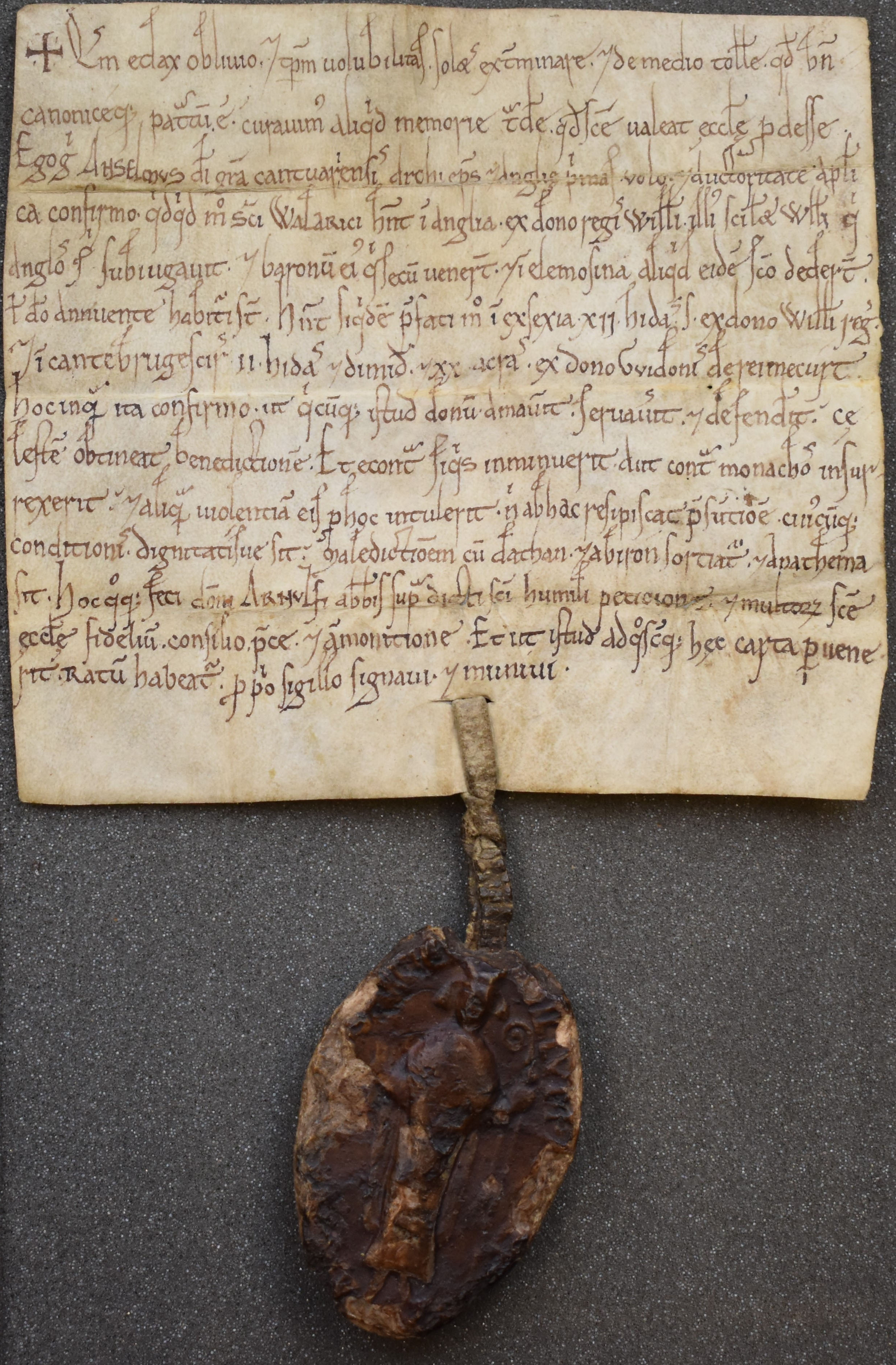
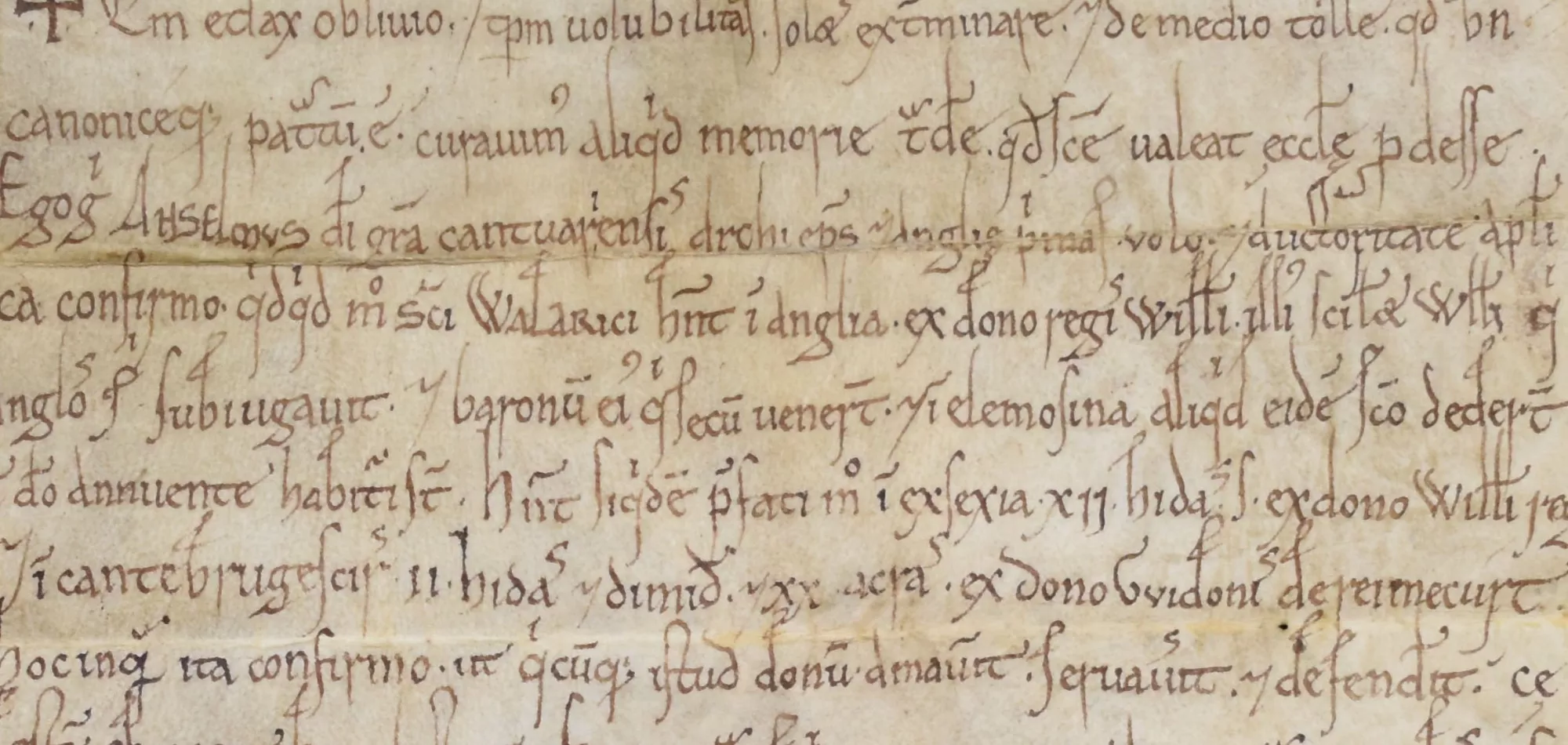
An image of a handwritten charter (New College, Oxford, NCA, 13152)The charter pictured here is one such document. Dating to 1097, it is, in fact, the oldest estate document in the New College Archives. It is a charter of Archbishop Anslem of Canterbury (d. 1109) and still has his original seal attached. The seal, though now much worn, shows Archbishop Anselm with his crozier (a bishop’s staff) in one hand and the Bible in the other. 

The content of the charter concerns the manor of Takeley in Essex. William the Conqueror had gifted Takeley to the Abbey of Saint-Valery in Picardy, France shortly after his conquest of England. He did this in gratitude for the saint’s provision, in response to prayers, of favourable winds which had carried the Norman fleet to England swiftly and safely. In this charter, Archbishop Anselm confirmed that Takeley belonged to the Abbey of Saint-Valery. Following the Conquest, it was common practice for members of the new ruling elite to gift land in England to abbeys and monasteries in France. Sometimes, the French religious foundations established satellite communities in England on the lands they owned. These communities, including the one at Takeley, became known as alien priories.

Eventually, after years of financial difficulties, the abbot sold the priory at Takeley to William of Wykeham to endow his colleges. New College received its possessions in Essex, including Takeley itself, and Winchester College was given the priory’s lands in Middlesex. King Richard II granted the licence for this sale on 10 March 1391, which was confirmed by Pope Boniface IX on 2 February 1392. 

 

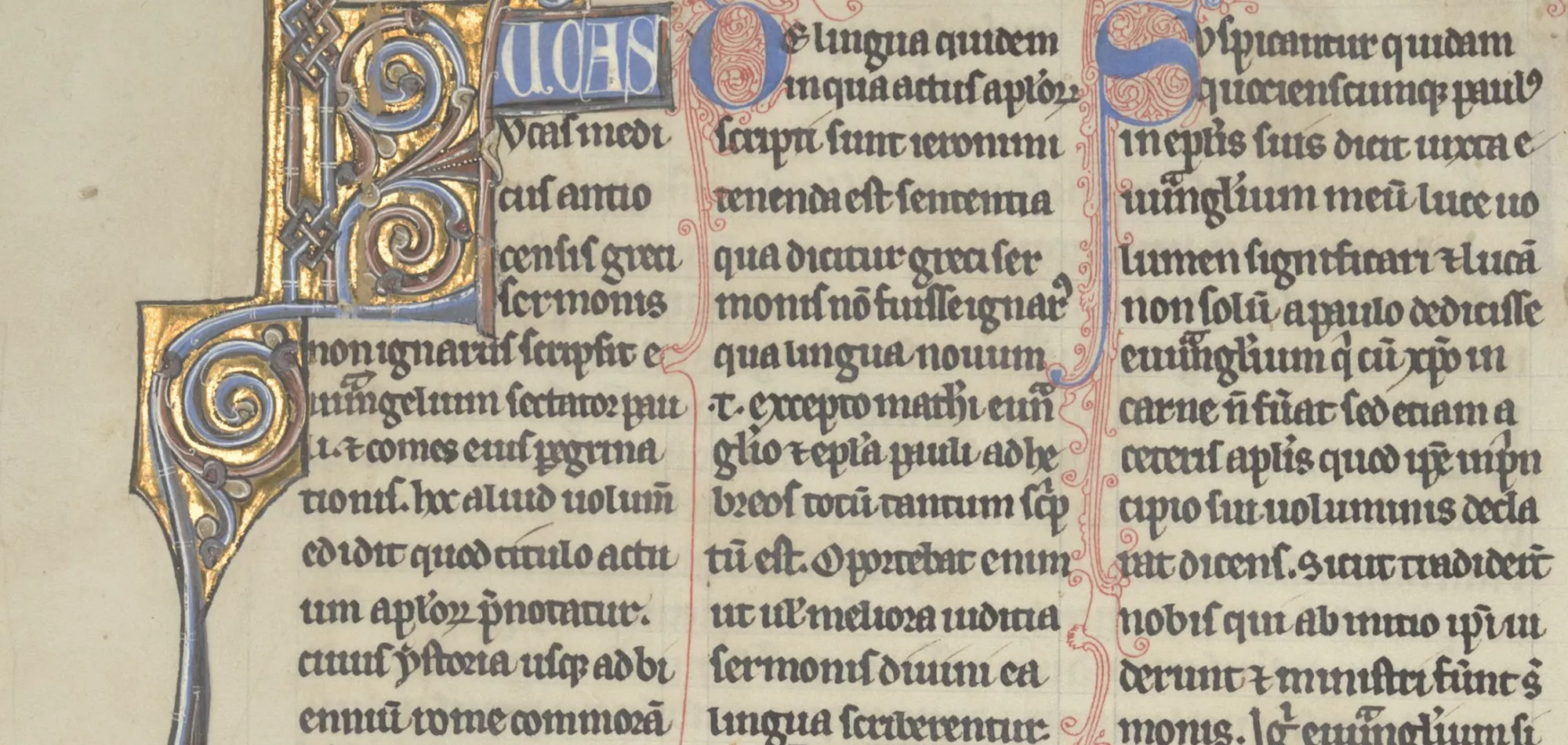
Detail of New College, Oxford, MS 27, f. 1r. William of Wykeham also presented this manuscript to New College.

Learning at College


In addition to endowing New College with considerable landed and material wealth, William of Wykeham supplied his foundation with many books. Wykeham wanted his college to produce well-educated men to swell the ranks of the secular clergy which had been depleted by plagues and pestilences, wars, and food shortages. He donated almost 250 manuscripts, an astonishing number for this time, to facilitate high standards of learning and teaching at his college. Roughly 10% of these manuscripts have remained in the care of New College Library to this day. Though this number may seem small, more manuscripts survive from the medieval library of New College than from that of any other Oxford or Cambridge college. Wykeham’s generosity encouraged others to follow suit and, consequently, the library was the first part of the college to need an extension, within 100 years of its foundation. 

  • Studying the Bible with New College, Oxford, MS 1

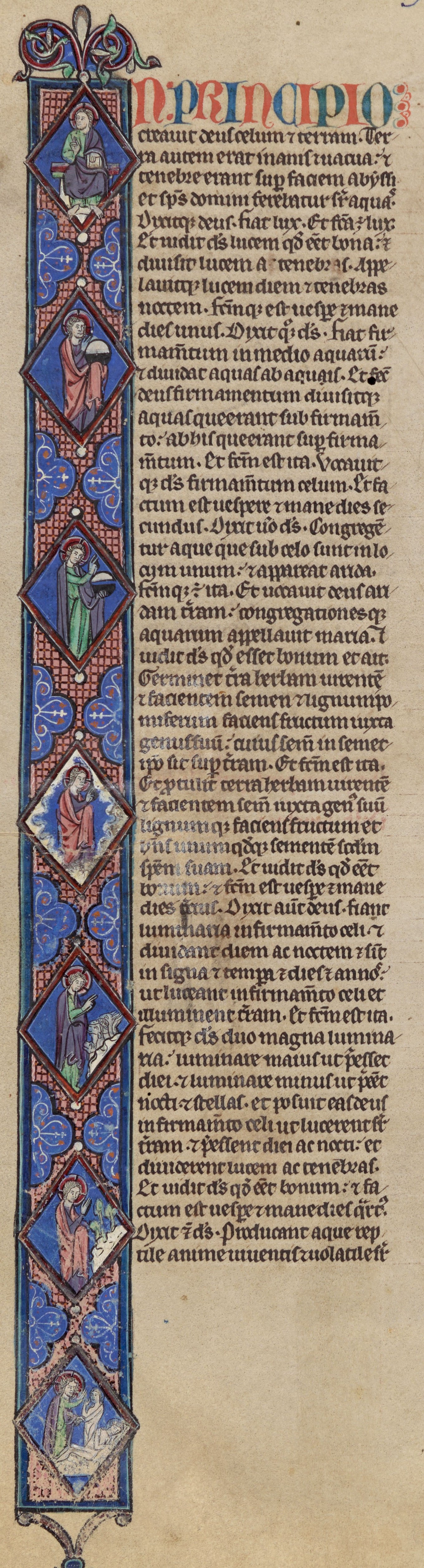
    Picture of an inhabited initial I with small pictures of God bringing to life different aspects of his creation.


    In line with his plans for the students at his college, most of the manuscripts from Wykeham’s donation concern theology—the study of the nature of God and Christian religious beliefs. Wykeham gifted many copies of the Bible, including this beautiful manuscript (MS 1). Written in thirteenth-century France, perhaps in Paris, it is a Latin biblical pandect—a volume containing all the books of the Bible. Marginal notes added to its pages show that this manuscript was actively used by generations of New College students.

    Each book of the Bible opens with a historiated initial, an enlarged letter containing a depiction of a recognisable person or scene from the text. This page contains the beginning of the Book of Genesis, the first book of the Old Testament. The large initial I is decorated with seven tiny depictions of key events from the Creation. God is shown making the heavens and earth, the sky, animals, and, finally, humans.

  • Studying Law with New College, Oxford, MS 183

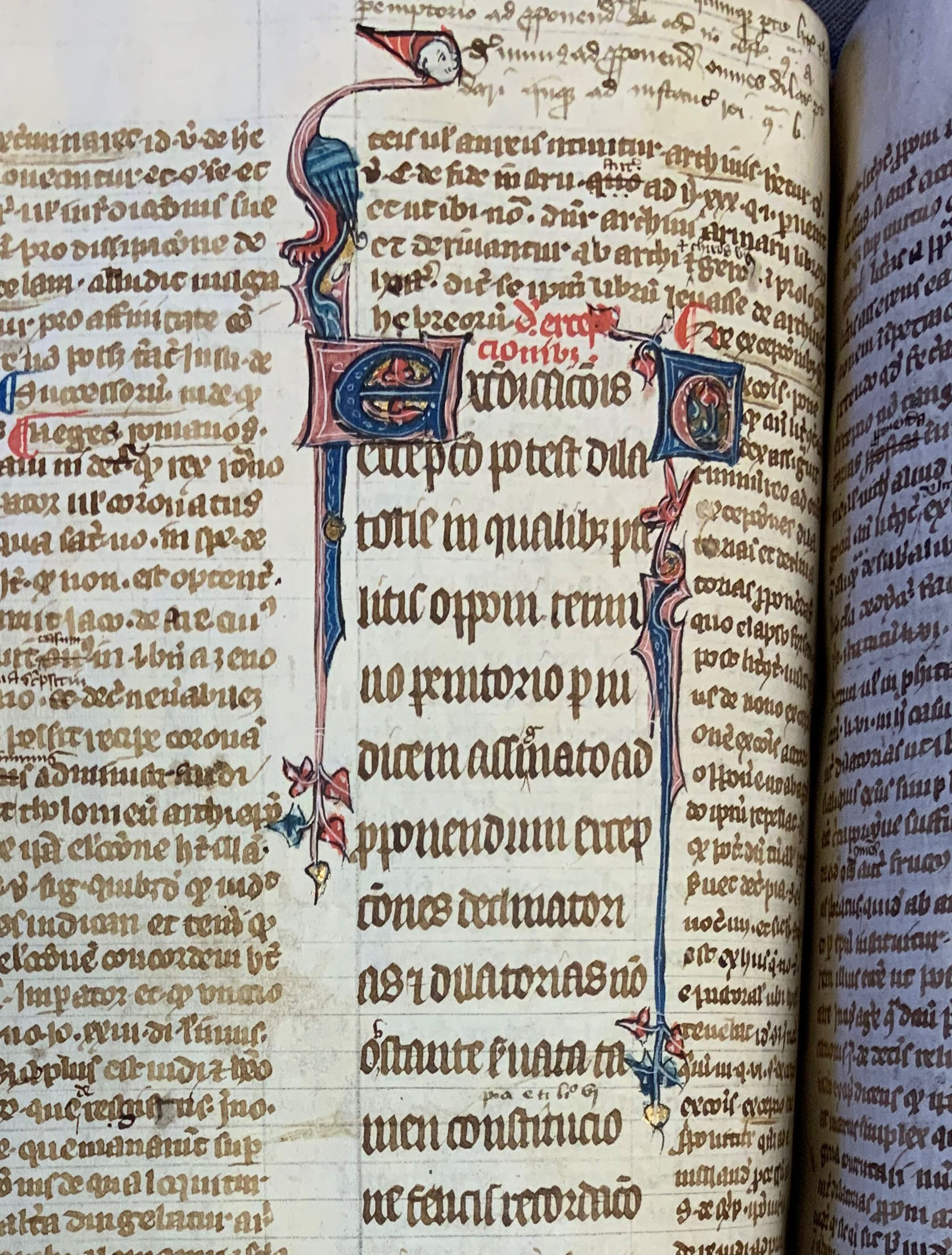
    MS 65, f. 65v (detail)Wykeham also gifted books to support the study of other subjects taught at New College, including law. This manuscript (MS 183), for example, is a compendium of canon law—the rules, decrees, and statutes of the Catholic Church. Made in England in the mid-fourteenth century, it contains the Constitutiones Clementiae (now known as the ‘Clementines’), a compendium of church legislation issued by Pope Clement V shortly before his death in 1314. This high-quality copy also includes commentaries on the text authored by the renowned fourteenth-century jurists Johannes Andrae and Guillaume de Mont-Lauzun. These are distinguished from the main text through use of a smaller script, as you can see here (f. 65v). Glosses (explanations and interpretations of the text) added in the margins demonstrate that this book was actively used by students of canon law at New College.
    Striking illuminated initials signal the beginning of each new section of the Clementines. Some are decorated with vine and leaf motifs. Others, including this one, are inhabited by weird and wonderful creatures. Lots of medieval manuscripts are decorated with mythical and monstrous beasts like these. Their purpose, still debated by scholars, probably varied in and across volumes. Here, they may have been designed to counter the seriousness of the canon law text. 

With much careful planning and astute forethought and the investment of considerable wealth through the acquisition of land, the construction of buildings, and the provision of manuscripts, William of Wykeham certainly set his “new college” up for success. 

Click through to the next section of the exhibition to learn how his foundation fared through the turbulent times of the Reformation.