Today, the collections cover the development of the discipline from its Ancient Greek origins right up to the research published by the Savilian professors themselves.
Deriving from the ancient Greek geo, meaning earth, and metron, meaning measurement, this branch of mathematics is one of the most influential in the history of humanity. First developed in Mesopotamia and Egypt to tackle practical problems resulting from the development of agriculture and trade, it was the Ancient Greeks that revolutionised geometry, not only coining the word itself, but more importantly putting it into a logical framework for the first time.
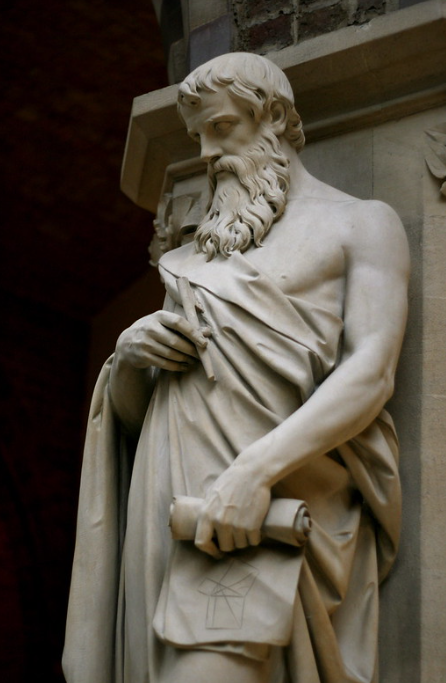
The most important Greek geometer has to be Euclid—his statue in the Natural History Museum in Oxford is depicted to the right. Building upon earlier geometric knowledge, Euclid revolutionised the subject with the publication of his Elements, which effectively put geometry into a logical framework. Starting from clear building blocks like points and lines, he made a series of assumptions, now called axioms or postulates, which could be proved with examples. Considered to be one of the greatest works compiled by man, Euclidean geometry was extremely influential. The Euclidean tradition is still visible in Newton's Principia Mathematica and Einstein even praised Euclid over two thousand years later, writing that his assertions 'could be proved with such certainty that any doubt appeared to be out of the question. The lucidity and certainty made an indescribable impression on me.’
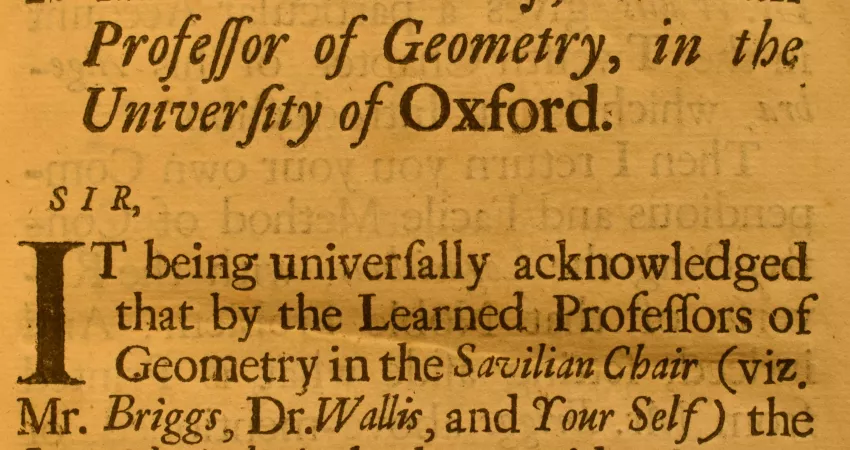
 As Euclid is such an important figure in the history of geometry, it is not surprising that he is well represented in New College Library's collections. Indeed, even Henry Savile himself lectured on Euclid, as you can see pictured on the left here. The book preserves Henry Savile’s lecture series on Euclid in
 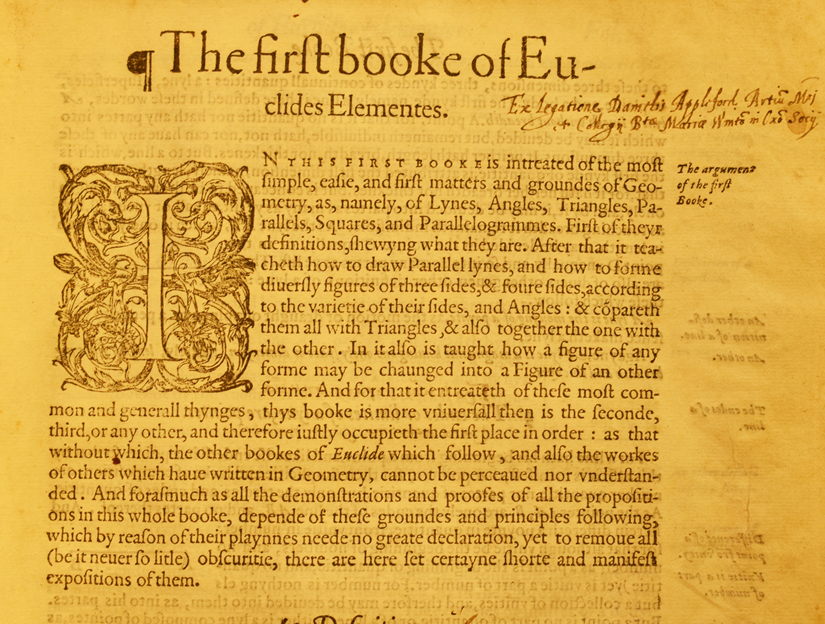 As Euclid was so influential, all undergraduates studying for the BA in the medieval and early modern periods were supposed to master at least the first six books of Euclid. Not much, though, is known about how geometry was actually taught in the university. The two books pictured here provide us with a glimpse into this teaching. Both were owned by the same man, Daniel Appleford, who studied in the college in 1645.
 The first, pictured on the right, is the London 1570 translation of Euclid into English,
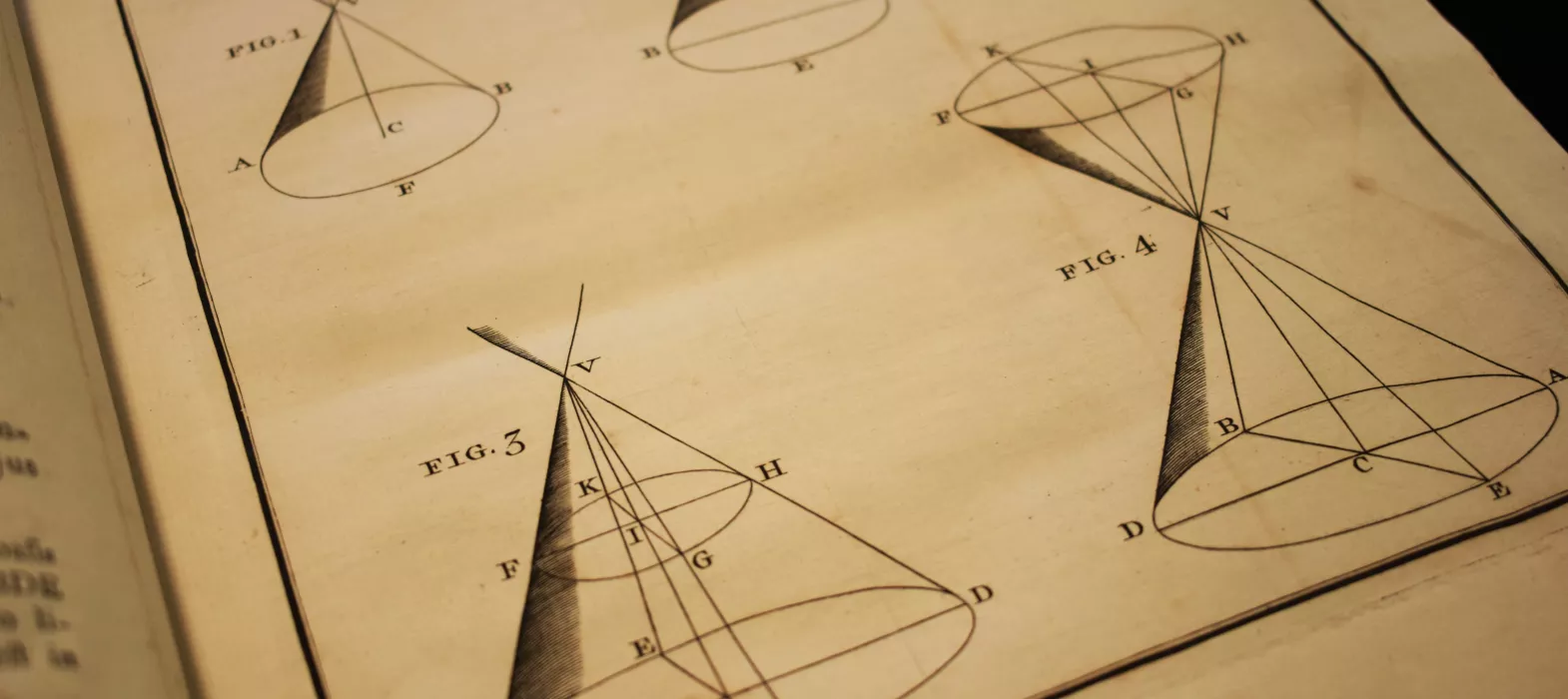
 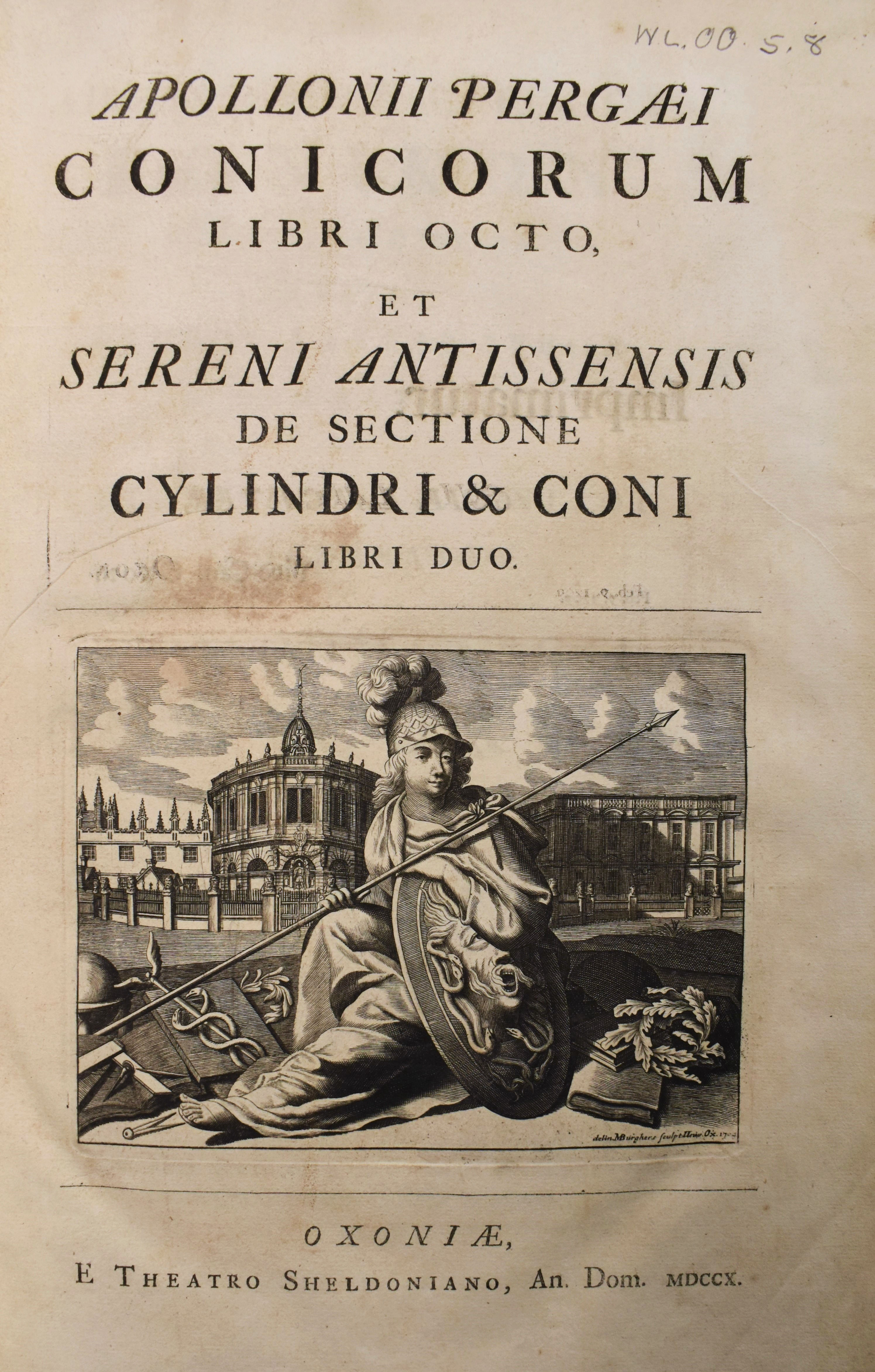 The first full mathematical theory following Euclid’s tradition was Apollonius’s, around a century after Euclid. His work, entitled The Conics, though, has come down to us in a battered state. A derived Greek text survives for the first four books, there is an Arabic version of the next three books, but the eight and final book is lost.
 Despite the importance of theory to the subject, the study of geometry has also always had very practical applications—right from the start of the development of the discipline as an area of study. This fact was, naturally, well-known to the Savilian Professors themselves. From their accommodation right in the heart of Oxford on New College Lane (pictured to the left), several Professors of Geometry reflected on the possible uses of geometry across many subject areas, ranging from fine art to algebra and astronomy. Unsurprisingly, much of their research made its way into New College Library, as can be seen in the books discussed below.
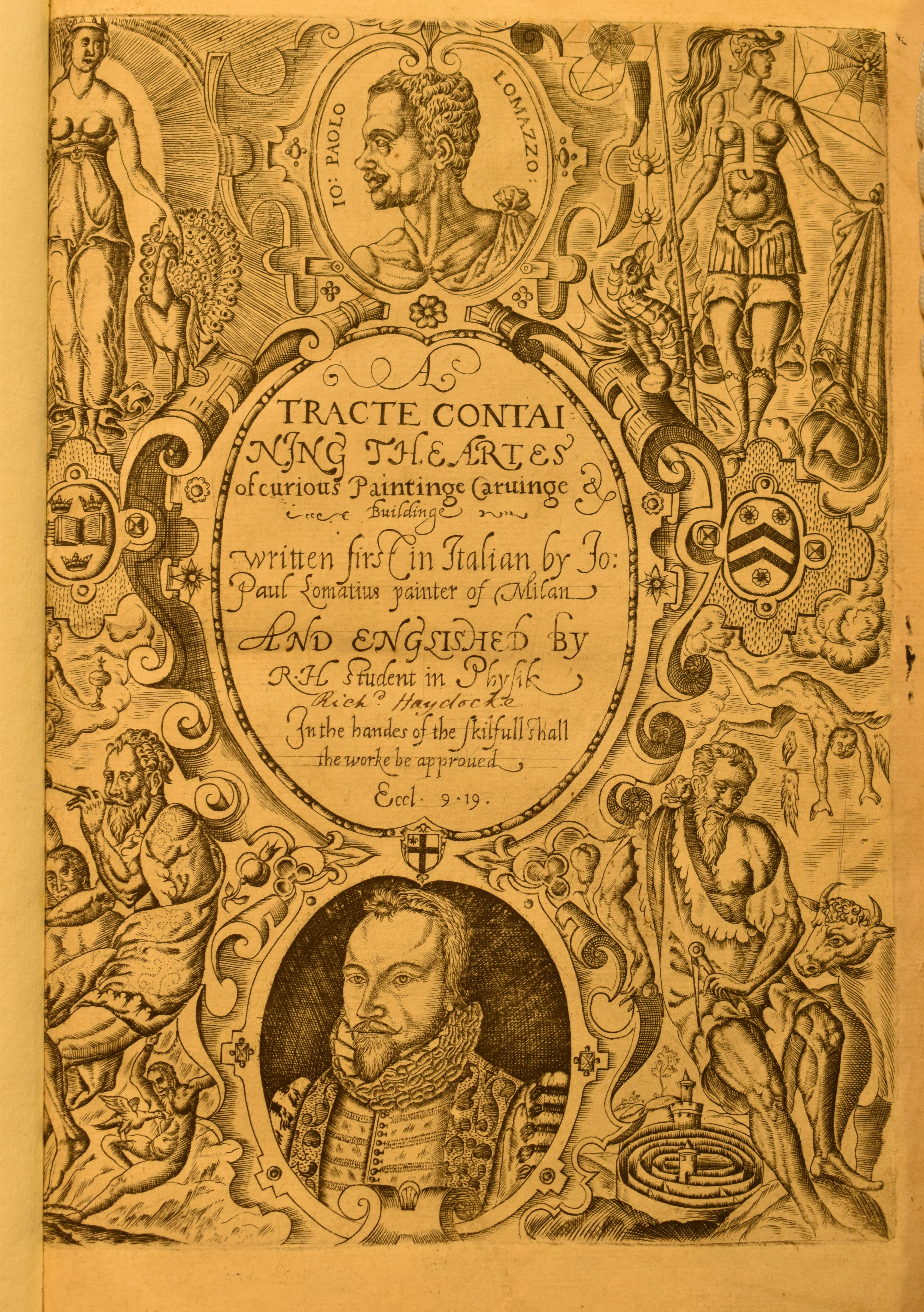 Geometry is, perhaps, the branch of mathematics that is most closely linked to art. Both involve the close study of different lines, shapes, and forms—and both attempt to use what can be depicted to convey meaning to the viewer. This link between science and art is personified in the book pictured below.
 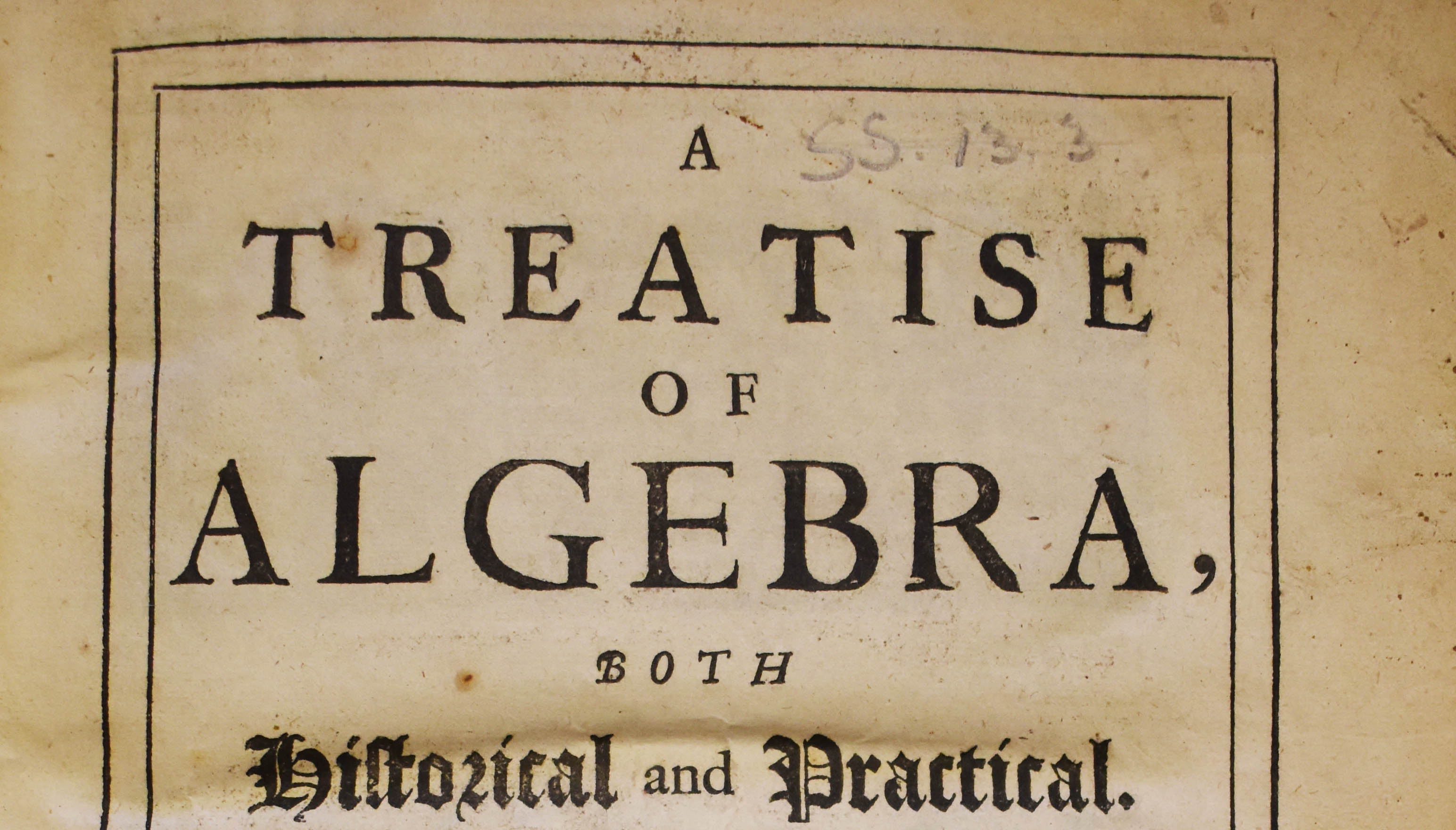 This book, pictured on the right, is arguably the most outstanding work of John Wallis, Savilian Professor of Geometry for fifty-four years in the seventeenth century (see the previous page for more information on his life). Published in his seventieth year, A Treatise of Algebra, both Historical and Practical, this work is unusual as it has both a theoretical and practical focus. The last 28 chapters are dedicated to the practical applications of algebra, focusing on the building block of calculus—an area greatly developed by Isaac Newton. Essentially the mathematics of measuring change, calculus has a wide range of practical uses today, from structural engineering to patient diagnosis, credit card payment structures to predicting weather patterns.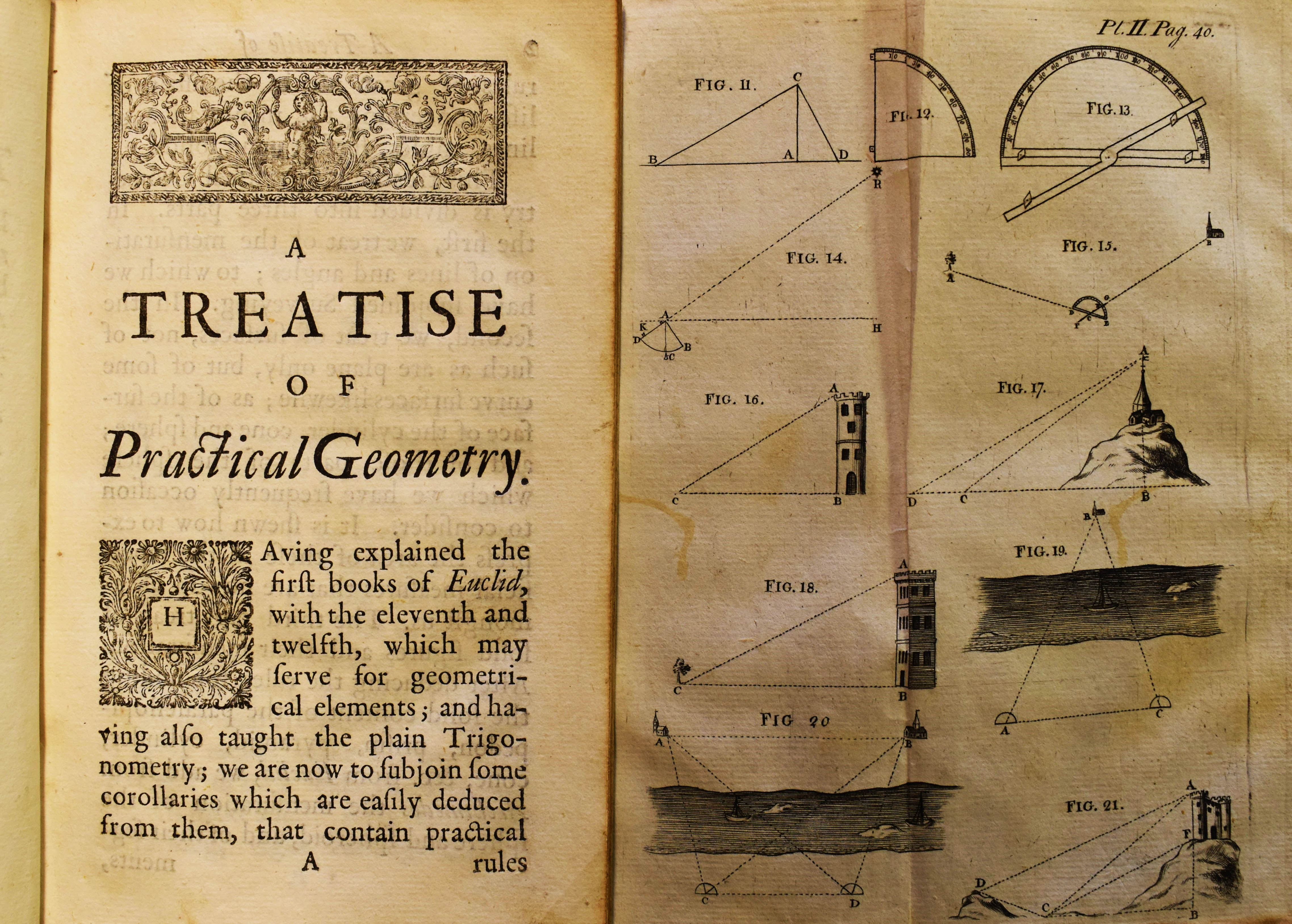
 matters astronomical and, though, a Scot, accorded fulsome praise to the achievements of the English. Newton's Principia is a touchstone throughout his lecture and he ends by calling John Wallis, Savilian Professor of Geometry from 1649 to 1703, ‘prince of geometers’.